3/5/26 ECEA Child Care Update
Mar 05, 2026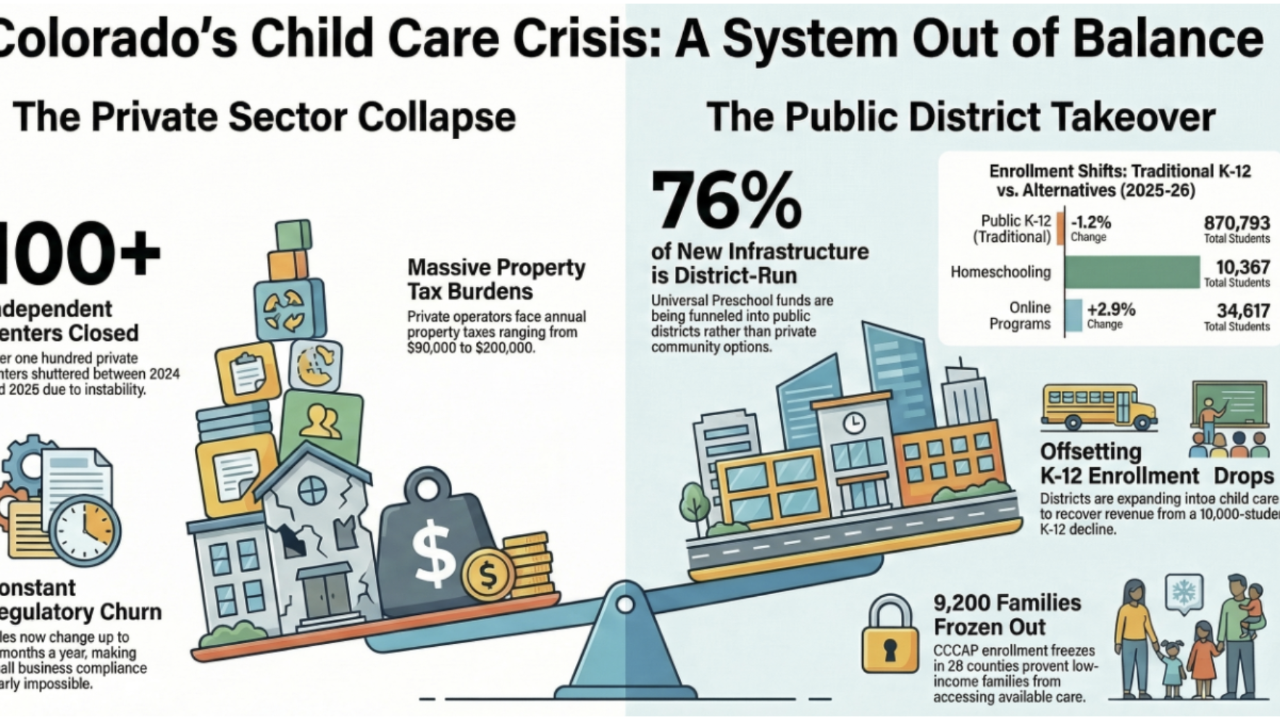
The child care industry in Colorado is at a critical crossroads, where the promise of a balanced "mixed delivery" system—combining private providers, community-based programs, and public options—is failing to materialize. Instead, government-run or -supported programs like the Colorado Child Care Assistance Program (CCCAP) and Universal Preschool (UPK) are increasingly undermining the landscape, squeezing out private businesses and limiting true family choice.
In the past, Colorado's child care operated mostly as a free market with limited government help through subsidies like CCCAP and some temporary COVID funds. Child care was expensive, but families coped, and experienced private operators ran stable programs with minimal interference.
Over the last decade, a flood of new regulations—meant to improve safety, quality, and equity—has overwhelmed private providers. Since the Colorado Department of Early Childhood (CDEC) formed in 2022, rules change frequently (often 10 months a year, versus once every 5 years per rule set before). This constant churn makes compliance nearly impossible for small businesses already running on thin margins, hit hard by high rents or property taxes ranging from $90,000- $200,000 a year around the state. We wonder, when will that process that was needed to "remain nimble" will be utilized to support the need for fewer regulations?
The result: massive instability. More than 100 independent child care centers closed (not sold or transferred) from early 2024 to early 2026, driven by declining enrollment, unfilled subsidized spots, and regulatory burdens. Official snapshots miss the full picture, but deeper data shows the damage clearly.
UPK's Impact: Favoring School Districts UPK aimed to offer free preschool (mainly for 4-year-olds, some 3-year-olds) while keeping a mixed model with choices between community and school settings. In practice, it funnels most new resources to school districts: about 76% of new licensed child care infrastructure since launch is district-run.
Districts have unfair advantages—property tax exemptions, access to empty public buildings, and extra funding. In Denver, districts convert vacant schools into early childhood centers (including infant-toddler spots). Statewide, districts hold onto $38.6 million in historical funds for 3-year-olds and push for more control through HB26-1259. This continues school districts to continue to pull young children from stable private programs into public ones, disrupting attachments and social-emotional development, now just because they are low income which is a duplicative function to what CCCAP offers.
Why the Push into Early Childhood? K-12 Enrollment Losses School districts face big drops in traditional enrollment. The 2025-26 school year saw statewide public school numbers (pre-K to 12) fall by over 10,000 students—a 1.2% decline to 870,793—the largest since early pandemic years. Declines hit most grades and districts.
School districts claim its due to lower birth rates and migration, but the reality is many families choose alternatives: homeschooling up 5.5% to 10,367 students (up 19.5% since 2022), online programs up 2.9% to 34,617, and combined charter/online/homeschool options serving over 138,000. Families cite behavioral issues, poor skill development, and dissatisfaction as reasons for leaving.
Instead of fixing K-12 problems, districts expand into early childhood via UPK to lock in younger students, use dedicated funds, repurpose buildings, and offset revenue losses—intensifying pressure on private providers.
Uneven Playing Field and Key Legislation Private centers pay steep property taxes while districts get exemptions, leading to defaults, cuts, and closures—net loss of private slots.
Bills like HB26-1282 would exempt district child care from some CDEC rules (seen as duplicative of education standards), widening the gap. Whether or not your are an ECEA member, we urge you to contact legislators now to oppose it and support SB26-020, which creates a task force to reduce overregulation across the industry.
CCCAP Struggles CCCAP enrollment freezes affect over 9,200 eligible families in 26 counties, blocking access to subsidized care for work or school and worsening hardship. Providers face empty slots, lost revenue, and closures. A program meant to help is harming families and businesses instead.
The Broken Promise and What Must Change Policies claim to support "mixed delivery" but consistently favor public options, eroding the private sector. Proposed fixes like the progressive tax initiative 195 for child care lack details on protecting private providers—no plans to offset their taxes, fund fairly, or consult providers directly to ensure the outcomes help sustain private industry. This risks total collapse of private options, leaving families with fewer choices. If the initiative passes it is critical that private industry has extensive opportunities to meet directly with those building statute language to minimize any further harm.
Colorado needs real balance: cut unnecessary regulations, fully fund CCCAP to lift freezes, hold public programs to equal (or tougher) standards, and ensure private providers can survive. Only then can genuine parent choice endure.
Come on, Colorado—we can do better.
ECEA Members Minute (click here)
Member's ONLY content this week. If you click on the title and can't access the content below reach out to Dawn for support.
- Legislative Summary
- Executive Briefing for CCCAP Rule Changes (new resource)
- General Rule Summary slides (new resource)
- Member Perspectives--you showed up and told us what you think about our program. Here's what everyone had to say!
- Advocacy in Action
- NEWS --A link to some stories about CO media in child care that you need to read.
Join ECEA Now and Make a Difference!
Centers: For $25 a month ($35 for Plus, $55 for Pro)
Homes/SACCs: For $8 a month unless you choose to join at a higher tier.
Stay connected with news and updates!
Join our mailing list to receive the latest news and updates from our team.
Don't worry, your information will not be shared.
We hate SPAM. We will never sell your information, for any reason.