|
NOTE: We have integrated two websites/mailing lists. If you receive this and do not want to, please scroll to the bottom and click unsubscribe.
CDEC UPK Ratio Decreases Will Undermine Your Business
Research included to demonstrate policy impact BEFORE the mistake is made.
Research & Policy Brief
Compliance Mandates and Child Care Quality: What the Research Actually Shows
This brief was prepared in response to CDEC's use of CEELO/NIEER materials to justify a decrease in UPK child-to-staff ratios for community-based programs in Colorado. It examines what the full body of research says about the relationship between compliance mandates, program financial health, teacher wellbeing, and actual child care quality - and demonstrates that the cumulative burden of regulatory requirements actively undermines the quality conditions the state claims to be creating.
Section 1: What the State's Own Source Actually Says - and What It Doesn't
CDEC has cited the CEELO toolkit page on class size (ceelo.org/toolkit/cpqr/class-size/) and its accompanying NIEER handout to support a reduction in the UPK child-to-staff ratio from 1:12 to 1:11. A careful reading of these materials reveals three critical problems with that application.
Problem 1: This is a staged decrease - and each stage imposes full cost without full funding support.
CDEC has signaled that the move to 1:11 is not the destination - it is the first step in a staged decrease toward 1:10. The research CEELO cites does support lower ratios as a quality indicator. What it does not support - and cannot support - is a staged, unfunded mandate that strips revenue from programs in waves before they can adapt even if it remains at 1:11, it removes the potential for 2 children in the classroom.
The programs CEELO identifies as effective - Boston's Public School Prekindergarten, New Jersey's Abbott Preschool Program, Oklahoma's Early Childhood Four-Year-Old Program - implemented low ratios with full public investment behind them. Teachers in those programs were not asked to absorb a ratio decrease through lost revenue. Their programs were designed and funded from the ground up to operate at those levels. Mandating a staged decrease on programs operating without equivalent investment does not replicate those outcomes - it imposes the cost structure of a well-funded model on programs without the funding to match.
Problem 2: UPK is publicly funded - which makes a ratio decrease a direct, locked-in revenue loss.
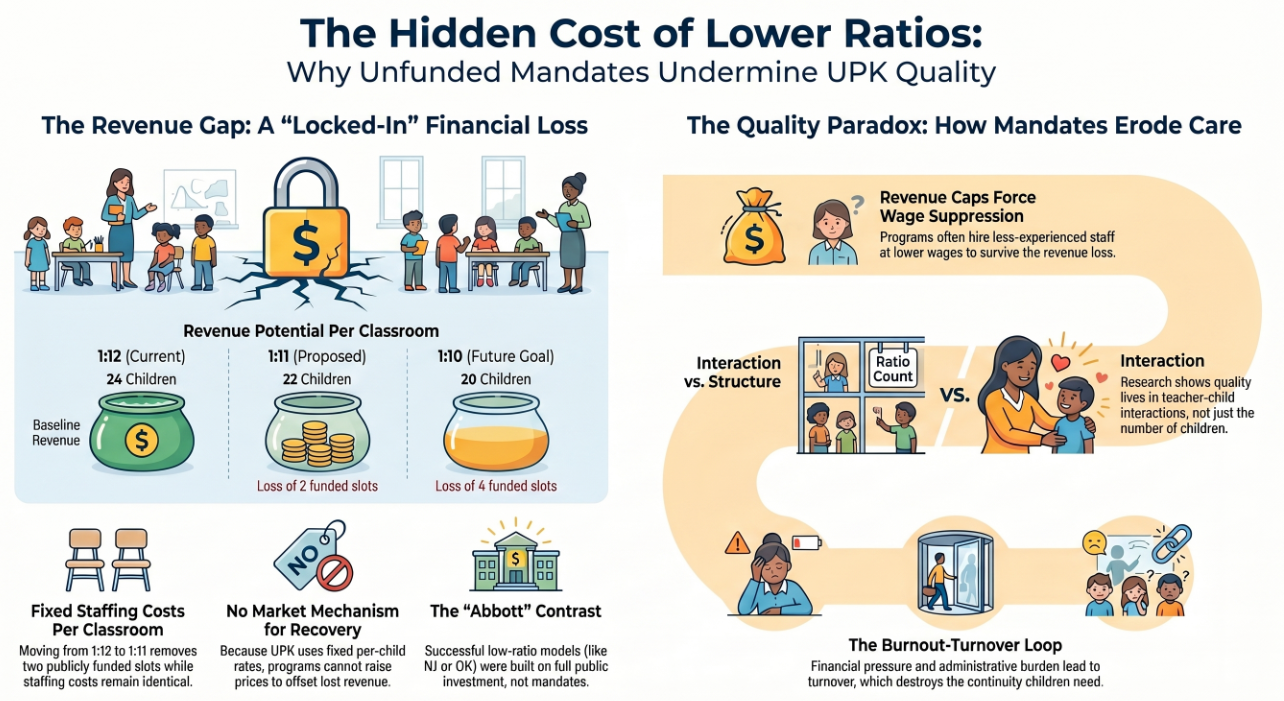
UPK funding flows as a per-child public subsidy at a fixed rate. That funding structure means a ratio decrease does not simply change how many children a teacher manages - it directly caps the number of publicly funded slots a classroom can generate revenue from. With two teachers in a classroom at 1:12, a program can serve 24 UPK children. At 1:11, that same classroom serves 22. That is two fewer funded slots per classroom - and unlike private-pay enrollment, there is no mechanism to replace that revenue.
Programs cannot raise the UPK rate. They cannot enroll additional children above the ratio cap to compensate. The per-child funding rate does not increase to offset the lost slots. The result is a structurally locked-in revenue reduction that programs have no market mechanism to recover from - while their staffing costs remain identical. This is not an abstraction: it is a specific dollar loss per classroom, per month, with no offset.
Problem 3: The document's own warning about teacher turnover is the argument against this policy - and CO UPK makes it worse.
The CEELO handout CDEC is using states explicitly: 'Low wages and limited opportunity for professional development and support often leads to high rates of teacher turnover. High teacher turnover has been found to negatively affect children's social, emotional, and language development.' This is not a peripheral note - it is in the state's own cited source, identifying the precise mechanism by which this mandate will harm the children it claims to protect.
Colorado's UPK structure compounds this pressure directly. A two-teacher classroom at 1:12 generates revenue from 24 UPK slots. At 1:11, that ceiling drops to 22 - a loss of two funded slots with no additional staffing revenue and no change in payroll cost. Programs absorbing that loss have less available for teacher wages, less for professional development, and less margin against turnover. The mandate does not just risk the quality conditions the document warns about - it systematically creates them, in every affected classroom, every month the policy is in effect.
The state cannot simultaneously cite a document that warns against low wages and high teacher turnover as threats to quality - and then implement a policy that reduces the revenue available to pay competitive wages and retain qualified teachers. That is not a quality argument. That is a contradiction.
Section 2: Ratios Are a Structural Measure - Quality Lives in the Interaction
A substantial body of peer-reviewed research distinguishes between structural quality measures (ratios, group size, physical environment) and process quality measures (the actual interactions between teachers and children). The distinction matters enormously for evaluating this policy.
Finding: Regulations often focus on easily observable structural measures like group sizes and child-staff ratios, which do not necessarily affect care quality but do increase costs. Process measures - which evaluate the quality of interactions between teachers and children - are more difficult to observe but are more closely related to positive child outcomes.
Source: The Impact of Regulations on the Supply and Quality of Care in Child Care Markets, American Economic Review / PMC (pmc.ncbi.nlm.nih.gov/articles/PMC4076055/)
Finding: Teacher-student interactions are the central element of classroom processes related to children's learning. Quality is measured across emotional support, classroom organization, and instructional support - all of which are determined by teacher capacity, training, and wellbeing - not simply by the number of children per teacher.
Source: Defining Early Education Quality Using CLASS-Observed Teacher-Student Interaction, Frontiers in Psychology (2023); Pianta et al., University of Virginia
Finding: Research confirms the importance of ratios, teacher training, and group size for quality classroom processes, but demonstrates the more significant contribution of teacher wages and the overall support environment. Ratios alone are an incomplete and insufficient proxy for quality.
Source: RAND Corporation, The Effects of State Regulations on Childcare Prices and Choices (rand.org/content/dam/rand/pubs/working_papers/2004/RAND_WR137.pdf)
Reducing a ratio by one child without addressing teacher wages, professional development, and program stability does not produce the quality interactions the research identifies as the true driver of child outcomes. It produces a structural change with no guaranteed process quality benefit - and a predictable, specific financial harm.
Section 3: How Compliance Mandates Undermine the Quality They Claim to Create
The relationship between compliance burden and child care quality is not speculative - it is well-documented. The mechanism works through a chain of predictable consequences that the research has traced consistently.
Step 1: MANDATE CAPS REVENUE
In the CO UPK model, a ratio decrease directly reduces the number of publicly funded slots a classroom can generate - with no mechanism for programs to replace that income. Two fewer UPK children per classroom means two fewer funded slots per month, every month, with unchanged staffing costs. Each new compliance requirement adds cost or removes revenue in a system where margins are already thin.
Source: AEI, Childcare Regulation and Affordability; U.S. Treasury, Economics of Child Care Supply (home.treasury.gov/system/files/136/The-Economics-of-Childcare-Supply-09-14-final.pdf)
Step 2: PROGRAMS REDUCE WAGES AND PROFESSIONAL DEVELOPMENT TO ABSORB LOSSES
When compliance costs rise and revenue does not keep pace, programs reduce costs where they can - most commonly by hiring less-experienced staff at lower wages, or by reducing professional development investment. Research documents that providers 'increasingly recruit lower-skilled teachers and staff as a means of cutting hiring costs while attempting to comply with stricter ratio and group size rules, and these responses put many childcare programs at risk of providing lower-quality instruction.'
Source: RAND Corporation, The Effects of State Regulations on Childcare Prices and Choices
Step 3: ADMINISTRATIVE BURDEN PRODUCES BURNOUT
Administrative load and lack of organizational support are documented as larger causes of burnout among child care professionals than children's behavior itself. Family child care providers who accept subsidies - including UPK - face additional administrative burden beyond licensing requirements, contributing to increased stress, burnout, and exits from the field. CO UPK's documentation, rating, and compliance requirements sit on top of an already heavily regulated environment.
Source: Burnout and Perceptions of Child Behavior Among Childcare Professionals, PMC (2025); Exploring Job Burnout Among Family Child Care Providers, ScienceDirect (2026)
Step 4: BURNOUT DEGRADES THE INTERACTION QUALITY THAT ACTUALLY MATTERS
When caregivers are overwhelmed, the quality of care suffers. Burnout leads to less emotional responsiveness, reduced patience, and higher staff turnover - directly undermining the teacher-child interactions that research identifies as the primary determinant of child outcomes. This is not a peripheral concern: it is the core quality mechanism breaking down under the weight of financial and administrative pressure.
Source: Childcare's Hidden Burnout Crisis, CityGov.com; NAEYC, Child Care in 'Unsustainable Status Quo'
Step 5: TURNOVER DESTROYS THE CONTINUITY CHILDREN NEED
High staff turnover negatively affects children's social, emotional, and language development - documented in the very CEELO handout CDEC is citing. Regulation that reduces wages and increases burden deters the most qualified teachers from remaining in or entering child care settings, producing 'a detrimental effect on overall quality of care.' For young children, relationship continuity is not a secondary quality indicator - it is foundational to development.
Source: CEELO/NIEER, Why Quality Matters in Pre-K; RAND Corporation; Urban Institute, Understanding Why Family Child Care Supply Has Declined
Step 6: PROGRAMS CLOSE - PRODUCING ZERO QUALITY FOR FAMILIES WHO LOSE ACCESS
Documented reasons providers close include 'inequitable subsidy payment rates, increases in requirements, center-centric regulations.' Between 2019 and 2021, 6,957 licensed family child care homes closed in 36 states - a 10% loss. When programs close, no quality improvement has been achieved. Access has been eliminated. The families CDEC claims to be serving have nowhere to go.
Source: Child Care Aware of America (2022); Urban Institute, Understanding Why Family Child Care Supply Has Declined
Every step in this chain is documented in peer-reviewed research. A ratio mandate that reduces UPK revenue per classroom without providing replacement funding initiates this chain in every affected program. The state cannot mandate structural quality while simultaneously creating the financial conditions that destroy process quality.
Section 4: The Mixed Delivery Contradiction
Colorado's commitment to mixed delivery requires that community-based private programs remain financially viable. The research is clear that program financial stability is not separate from quality - it is a prerequisite for quality.
Finding: The imposition of regulations reduces the number of center-based child care establishments, especially in lower-income markets. In markets where programs already operate on thin margins, compliance costs that cannot be passed to consumers through higher prices lead directly to closure.
Source: The Impact of Regulations on the Supply and Quality of Care in Child Care Markets, American Economic Review; AEI, Childcare Regulation and Affordability
Finding: Research calls for 'right-sizing' regulation - reducing burdensome requirements that are not directly tied to child health, safety, and quality learning. There is no research basis for the position that every structural mandate produces quality improvement, particularly when the mandate's cost threatens program viability.
Source: Center for American Progress, A Path Forward on Child Care Regulation: Differentiating Between Harmful Deregulation and Helpful Reform
Finding: Child care quality is a function of investment, not mandate. The crisis in child care is the result of chronic underinvestment - not under-regulation. Compliance requirements imposed without corresponding financial support do not improve quality; they shift cost onto providers who have no mechanism to absorb it.
Source: NAEYC, Our Child Care Crisis Is the Result of Underinvestment, Not Overregulation
Mandating 1:11 ratios for four-year-olds in private child care programs - then placing those same children in kindergarten classrooms with 1:20 to 1:23 ratios - is not a coherent quality framework. It is a box checked at age four and abandoned at age five. The research on teacher-child interaction quality does not have an expiration date at kindergarten entry.
Section 5: Summary for Policymakers
State's Claim: Reducing ratios from 1:12 to 1:11 - with a staged path to 1:10 - improves quality for children.
What the Research Shows: The programs cited as effective (Boston, Abbott, Oklahoma) implemented low ratios with full public investment - they were designed and funded from the start to operate at those levels. Mandating staged ratio decreases on community-based programs without equivalent funding does not replicate those outcomes. It imposes the cost structure of a well-funded model on programs without the resources to match, in waves, before programs can adapt.
State's Claim: UPK is publicly funded, so ratio decreases are manageable.
What the Research Shows: Because UPK is funded on a fixed per-child rate, a ratio decrease directly and permanently caps the revenue a classroom can generate. Two teachers at 1:12 serve 24 funded children. At 1:11, they serve 22. Programs cannot raise the UPK rate, cannot enroll above the cap, and cannot replace the lost revenue through any available market mechanism. The public funding structure makes this a locked-in revenue loss - not a manageable adjustment.
State's Claim: This is about quality for children.
What the Research Shows: Quality lives in teacher-child interactions - not in structural ratio numbers alone. The CEELO document CDEC is citing explicitly warns that low wages, limited professional development, and high teacher turnover undermine quality. CO UPK's ratio mandate reduces the revenue available to address exactly those conditions - in every affected classroom, every month. The mandate does not create quality. It creates the financial pressure that the state's own cited research identifies as the mechanism of quality loss.
State's Claim: Programs can pursue alternate rating pathways to avoid the impact.
What the Research Shows: Provider data demonstrates this pathway is cost-prohibitive, time-unavailable, and carries embedded risks for programs that choose it over CO Shines rating. An option that is practically inaccessible to the programs it is supposed to help is not a solution - it is the appearance of one.
Prepared by the Colorado Early Childhood Education Association | [email protected] | 5/21/26
Full citations and source links are included throughout. This brief may be shared with CDEC leadership, RAC members, legislative staff, and media linked here.
And In Case You Needed More Convincing about policy Impacts on Business....
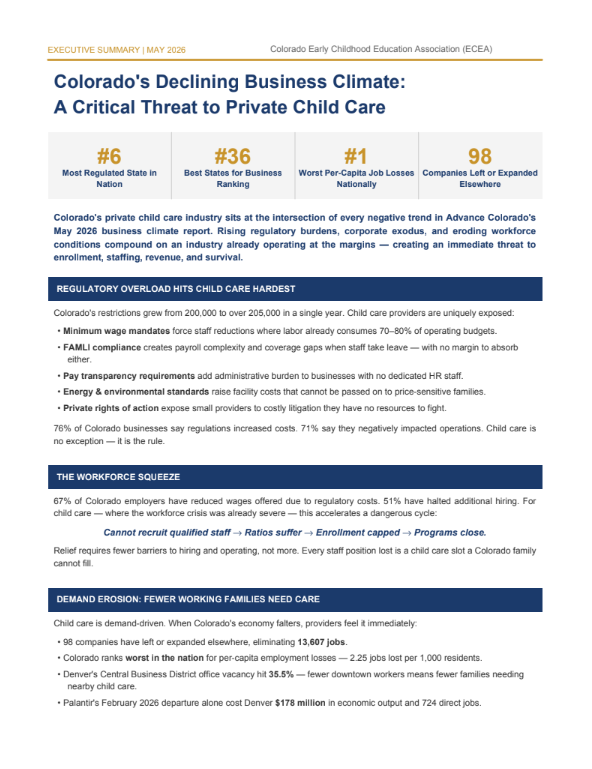
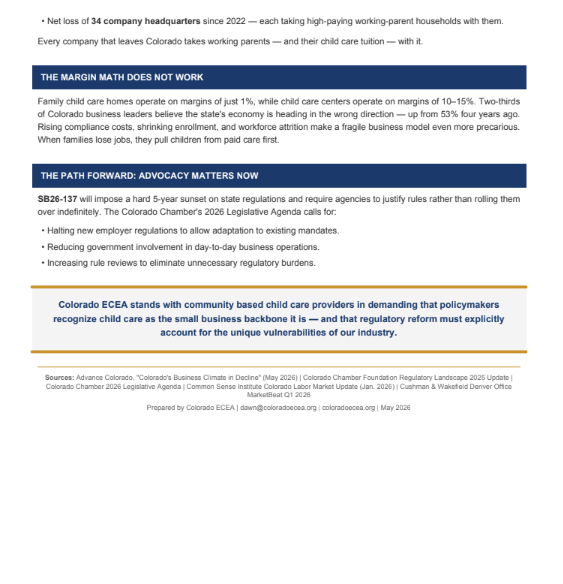
Link to Original report: https://www.advancecolorado.org/institute/colorados-business-climate-in-decline/
Link to pdf from ECEA: https://drive.google.com/file/d/1Pk1NoD3xsu2sBJrLeVElJaWikrvMlx_X/view?usp=sharing
Next week we will share what providers are telling us beyond the comments we are sharing at: facebook.com/ECEAofColorado where through yesterday, we've had 17,113 page views. Way to support the industry!!
ECEA is Bringing Innovative Health Solutions to CO Child Care....and you DON'T have to be a member to get it. Programs are signing up now...why aren't you?


Drive down your major medical costs as you decrease urgent care and emergency room visits by up to 70%. If you have 10 or more full time employees, you actually SAVE on taxes and that generates more revenue for you and your staff! Let us know you are interested (no obligation) at ECEAVR.com and Dawn will reach out to give you all of the details and to connect you with the right people! Or Schedule with Dawn directly to discuss your questions!
ECEA Members Minute -
We've been so busy with policy papers that we don't have much to share for members only this week. Although, if you have a early childhood educator that is interested in serving on a board for a new non-profit who's mission is Media Literacy Education, let me know and I will connect you!

https://eceaco.mykajabi.com/?cid=854b2295-1917-4c7b-966e-434cf0abacb5join-ecea-today
|