NOTE: We have integrated two websites/mailing lists. If you receive this and do not want to, please scroll to the bottom and click unsubscribe.
What's Really Happening: CDEC, NIEER, and Your Business
The rulemaking hearing is May 28th. Here's what you need to know — and why showing up still matters.
We're going to be straight with you. That's what we do.
You've heard us talk about the Rules Advisory Committee (RAC) process. Year after year on one occasion or another you've submitted testimony on the ratio issue. You've shared your numbers, your concerns, your reality. And you've watched CDEC bring the same issues back around, again and again, until they land on an outcome that moves Colorado closer to where they want to go. That process is happening again — right now — and the rulemaking hearing is Thursday, May 28th.
So what is CDEC actually chasing? Let us show you.
The Real Benchmark: Not Colorado Kids. NIEER.
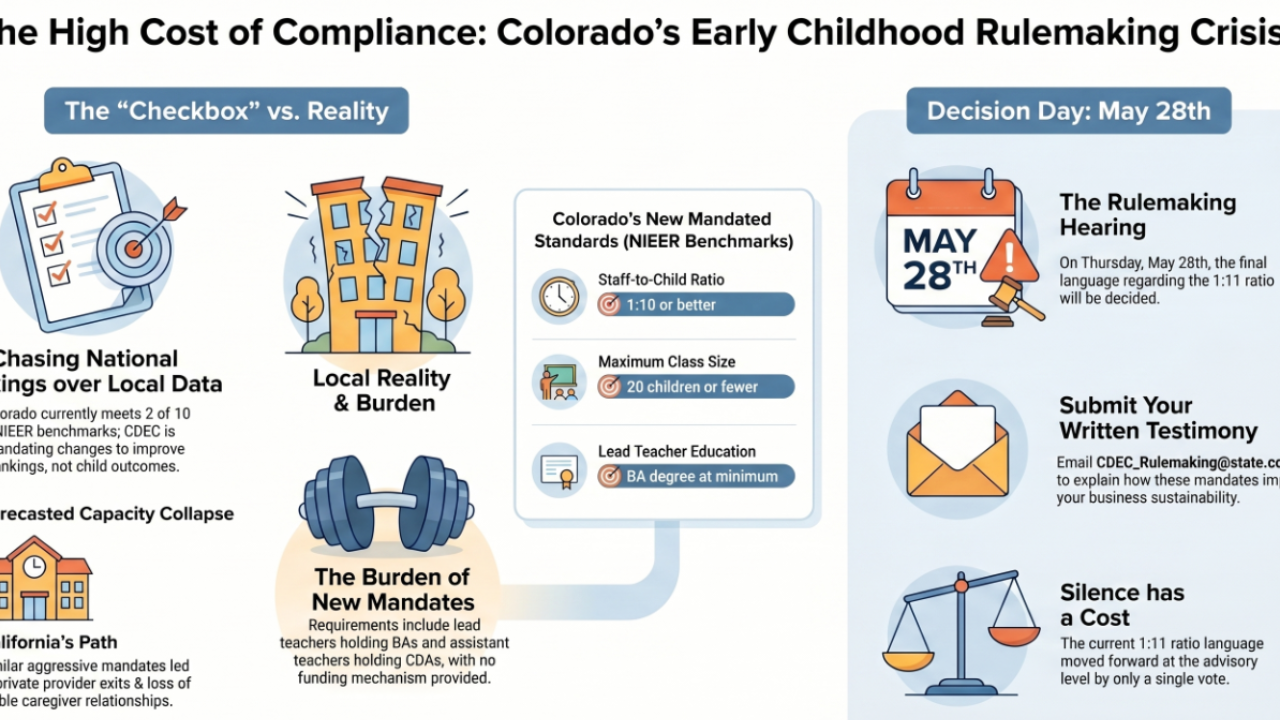
The National Institute for Early Education Research (NIEER) publishes an annual "State of Preschool" report that scores states against a set of quality benchmarks. Right now, Colorado meets 2 out of 10 of those benchmarks. That is what this is about. Not data showing Colorado children are struggling. Not evidence that our current ratios produce worse outcomes. Not research proving that forcing a lead teacher to hold a BA — rather than the deep, specialized experience they may already have — improves a child's life.
It's about a checkbox. A national ranking. A label.
Here is what NIEER considers a "quality" program, and what Colorado is now mandating or moving to mandate:
- Lead teacher must hold a BA, at minimum
- Lead teacher must have specialized training in a pre-K area
- Assistant teacher must hold a CDA or equivalent
- Staff must receive at least 15 hours/year of professional development, individualized PD plans, and coaching
- Maximum class size: 20 children or fewer
- Staff-to-child ratio: 1:10 or better
- Vision, hearing, and health screenings required
- Systematic classroom observations used for program improvement
These aren't suggestions. They are headed toward being requirements — for your business — with no reliable mechanism to fund the cost of compliance.
What the Data Actually Shows
Colorado law requires data-informed policymaking. We take that seriously — even when it seems like CDEC doesn't.
Yesterday, we presented data showing the real-world impacts of these policy changes on classrooms and on the providers who operate them. Provider after provider has told CDEC the same thing: these mandates are not sustainable. They don't describe the market you're operating in. They describe a publicly funded program being layered on top of a private business model — and the math doesn't work.
What we haven't seen from CDEC is Colorado-specific research demonstrating that:
- Higher ratios (1:12 children per teacher as we've done for decades) produce worse outcomes in Colorado settings
- Children in Colorado classrooms are falling behind in ways that these mandates would fix
- The loss of stable, trusted caregiver relationships — which will result from forcing provider closures — has been weighed against the projected benefits
These are not unreasonable demands. They are the standard. And Colorado has the data infrastructure to answer these questions, if they chose to ask them.
They're not asking.
The California Warning
We keep hearing that this is a national trend, so Colorado should follow. We'd ask you to look at what that trend has actually produced. In California and other states that have moved aggressively in this direction, the result has been the same: private providers exit the market. The children who depended on those providers lose their spots. The stable relationships that research consistently identifies as foundational to early childhood development — gone.
This is not a quality outcome. This is a capacity collapse dressed up as a quality upgrade.
We Didn't Build CDEC to Do This to You
We want to say something that's hard to say, but you deserve to hear it.
When the early childhood community — including organizations like ours — worked to build the system that became CDEC, we believed we were building something that would support and strengthen the full mixed-delivery system Colorado has always valued. Private providers. Home-based settings. Center-based care. All of it.
We were wrong about how that authority would be used. One memo from leadership can make every voice in every public meeting irrelevant. We've watched it happen befire and it may happen again. And we as an industry helped build the mechanism that allows it.
We're not going to pretend otherwise.
May 28th is Decision Day
Let's talk about what silence already cost us.
At the RAC, the vote was close. Too many RAC members opted out, uncertain what to do, unsure if it mattered, and it did matter. By a single vote, the language moved forward. That is not an abstraction. That is the most concrete example we have of what inaction produces.
The 1:11 ratio language is now in the proposed rule set. The clock is running. Dr. Lisa Roy has the authority to look at the volume and weight of public input and say: this is not the moment to make a change that further undermines provider enrollments. She could say that. Whether she will depends, in part, on what she hears from you.
Here's the other hard truth: CDEC has already accomplished much of this erosion through the way they use the enrollment algorithm. The rule change is the formality. The NIEER checkbox is the goal. The 105 community-based providers who would have been directly impacted last year can be made to seem like a small number if you let that framing stand. Don't. Because this sets the baseline — and that baseline follows your business indefinitely.
You know what to do. Here's the list:
If you need support on any of these steps, email [email protected]. We will help you find your words.
To every provider who responded to our survey last week — thank you. We are presenting that data to CDEC on Tuesday, and as promised, your anonymity is protected.
We won't promise you a specific outcome. We never have. What we will tell you is this: look at the full list of requirements on the horizon. Do you see the unfunded mandates slowing down? For every new mandate, there should be a corresponding rate increase to absorb the cost. Notice which items they're rushing — the ones that cost you revenue. Notice which ones are moving slowly — the ones that would cost them money to build.
Engage, and you have a voice in what comes next. Don't engage, and you've made a choice too. If you've done it before...this is your LAST chance to do it again.
----------------------------------------------------------------------------------------------------------------------------------------------------------------------------------------------------------------------

_____________________________________________________________________________________
ECEA is the only statewide Trade Association that supports community based programs. Whether you are a home, or a center, privately owned or non-profit, we elevate your voices to effect change in the industry. The work we've been doing over the past weeks? That's the kind of work we do for our members every week. Advocacy matters but it's not free. Thank an ECEA member for their help in sustaining our industry. Better yet...join today!

https://eceaco.mykajabi.com/?cid=854b2295-1917-4c7b-966e-434cf0abacb5join-ecea-today
|