
Colorado Is Losing Families. Private Child Care Is Losing Ground. That Is Not a Coincidence.
The population is shrinking. Businesses are leaving. Regulation keeps climbing. And while the private sector contracts, public school districts are expanding into early childhood on a playing field that has never been level. This week, the numbers.
The numbers are telling a story. Colorado needs to listen.
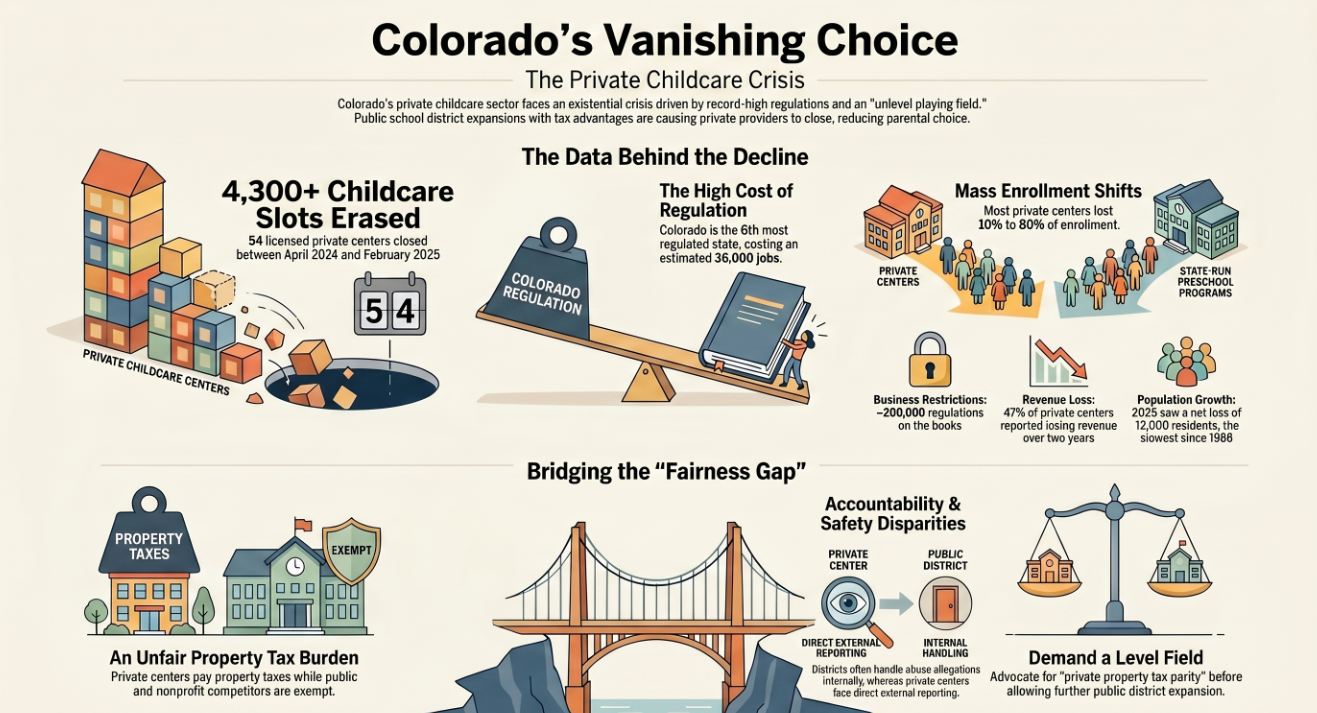
For the first time in decades, Colorado lost more residents than it gained. In 2025, the state had a net loss of roughly 12,000 people to other states and grew just 0.4%, slower than the national rate and the slowest pace since 1989.
We are now ranked the sixth most regulated state in the country, with roughly 200,000 business restrictions on the books. Economists studying the data estimate that every 10% increase in state regulation costs Colorado 36,000 jobs and 9,000 firms. That is not an ideology that is a measured relationship.
54 licensed child care centers closed between April 2024 and mid-February 2025, erasing more than 4,300 slots. Forty-seven percent of centers reported losing revenue over the last two years, and most lost between 10% and 80% of their enrollment to the state Universal Preschool program.
These are not separate stories. They are the same story, told from different angles, and the child care industry is where that story hits families most directly.
The TABOR question, and what SB26-135 is actually asking
This session, SB26-135 would refer a measure to voters in November 2026 asking the state to keep revenue above the TABOR and to increase public K-12 funding by up to 2% per year for ten years. The sales pitch is familiar: districts are shrinking and need more money.
Four of Colorado's 15 largest districts including Cherry Creek, Aurora, Colorado Springs 11, and Brighton-based 27J now offer preschool in more than 90% of their buildings. That is not a mixed-delivery system. That is absorption of our industry.
Ballot Initiative Gathering Signatures
In addition there is work to add a progressive tax called a "fair tax" to the ballot that would fund child care, yes, as the 3rd priority. School districts as the first priority. Some say that this initiative will save child care. You need to decide! The questions we have to raise are, have the 2 State operated programs (CCCAP and UPK) helped you or hurt you? Every program will have a different response based on their experiences and that experience will likely determine your stance on this ballot initiative. Maybe your experience is mixed. Sometimes the programs work supportively, sometimes they don't.
Will another government administered program help your business to succeed or fail? You have to decide. Either way, ECEA will be advocating for you and your business!
The field has never been level. Let's name that out loud.
Public school districts do not pay property taxes. Qualifying nonprofit child care centers don't either, a carve out expanded by HB22-1006 in 2022. Privately owned child care businesses do. We compete for the same families, chasing the same state dollars, without the same cost structure.
Their advantage applies pressure. Programs evaporate under it. And families wake up one morning with no private option left in their neighborhood.
In any conversation that involves state or local funding, elevate your voice to say, "Prove it! Pay private property taxes to level the field FIRST to ensure mixed delivery!"
When a privately owned program closes under that pressure, the district absorbs the children. The per-pupil funding follows them. The district grows. And parents in that community lose a choice they didnt know they were about to lose.
What parents are not told the day they enroll
Here is the part marketing brochures skip. In Colorado, when an abuse or neglect allegation involves a school employee acting in their official capacity, districts are required to communicate with the Colorado Department of Education, not to the county and they are also part of the response. State guidance is clear that school personnel should not investigate suspected abuse themselves. Yet the district, as the employer of the accused, has every structural incentive to control the narrative. Jefferson school district has had 38 documented cases of abuse/neglect in recent years that the parent group, Jeffco Kids First, knows about.
A 2025 change to Colorado law (effective September 1, 2025) now requires mandatory reporters to report directly to authorities, not to a supervisor. That change exists precisely because past cases showed reports dying at a principal's desk. It is a correction. It is not a cure.
Parents are also not told that for serious incidents, meaningful action often requires a School Resource Officer, a community-based police officer assigned to the school. And in districts across the state, relationships with SROs have been strained, reduced, or temporarily removed, leaving families to navigate the gap.
Parents are not told that "we can't share who assaulted your child" is often a liability posture rather than a kindness. Districts are also employers. The second a child enters the system, the system is structurally motivated to protect itself first, even when the family in front of it deserves otherwise.
And when reports surface that a district in the Adams County area paid a suspended superintendent north of $190,000 to retire quietly, while the same district testifies that it needs more money at every budget hearing, parents deserve to see how the money is actually moving.
The quiet cost young families are paying
A three-year-old pulled out of a consistent, caring, community-based program and placed into a district preschool is not a budget line. But to the system receiving them, that is exactly what they become: per-pupil revenue. Without extensive parental involvement, the social-emotional continuity that was helping that child thrive is traded for convenience and the parents making that trade rarely understand what they are giving up.
We are not saying that teachers in school districts don't care for the children they teach. We are saying that the system is failing students and parents are figuring that out. Full-time homeschooling in Colorado has continued to grow, with reported numbers increasing by 5.5% for the 2025-2026 school year, reaching 10,367 students, while part-time homeschooling reached 18,740. Since 2022, overall homeschooling in the state has climbed nearly 20%.
This is why your program is not "just a business". It is infrastructure for Colorado families. It is, for thousands of children, the most stable caring adult relationship outside their own home.
What to do with this information
Advocacy starts inside your own four walls. Share this with your parents. Show them the math. Tell them what their tuition actually buys that the district model does not: continuity, transparency, and a relationship that is accountable to them, not to a board managing an enrollment number.
Tell your legislators that SB26-135 is not a clean "fund the schools" vote when the funding model is simultaneously absorbing the private sector that has raised Colorado's children for the last fifty years. Ask the harder question: if districts need more revenue while losing enrollment, why is expansion into our industry the answer rather than the problem?
Colorado does not need fewer choices for parents. It needs a level field, honest accounting, and a regulatory environment that keeps small businesses that are shaping the next generation alive.
Sources
- Colorado Public Radio (Jan 2026) Colorado's population growth is slowest since 1989 as thousands leave for other states.
- Colorado Sun (Jan 2026)Colorado now has 6 million people, even amid slowing population growth.
- Colorado Chamber Foundation (2026) Report on 98 companies relocating or scaling back since 2019.
- Colorado Politics (April 2026) Colorado saw job losses for the first time since pandemic.
- StratACUMEN / Colorado Chamber of Commerce (Dec 2024) Study ranking Colorado 6th most regulated state; jobs and firm-loss estimates per 10% regulation increase.
- The Sum and Substance (2025) Child care center closures, CCCAP enrollment halt, and UPK revenue impact.
- Colorado General Assembly SB26-135 bill summary (leg.colorado.gov/bills/SB26-135).
- Chalkbeat Colorado (May 2024) Colorado public schools increasingly bring preschool in house.
- Colorado Department of Local Affairs, Division of Property Taxation Exemptions for schools and qualifying nonprofit child care centers; HB22-1006.
- Colorado Office of School Safety and Child Protection Ombudsman Mandatory reporting guidance; investigation is the role of child protective services, not school personnel.
- Chalkbeat Colorado (Aug 2025) New Colorado child abuse reporting law effective Sept. 1, 2025.
- Chalkbeat Colorado (Sept 2025) Three Denver high school campuses operating with temporary SROs after full-time officers reassigned.
- Colorado Politics (July 2025) Homeschooling grows in Colorado as worries over safety, drugs, bullying overtake religious motives.
ECEA Members Minute (click here)
Member's ONLY content this week. If you click on the title and can't access the content below reach out to Dawn for support.
- Legislative Summary
- Solved! ECEA wins for you.
- Advocacy in Action
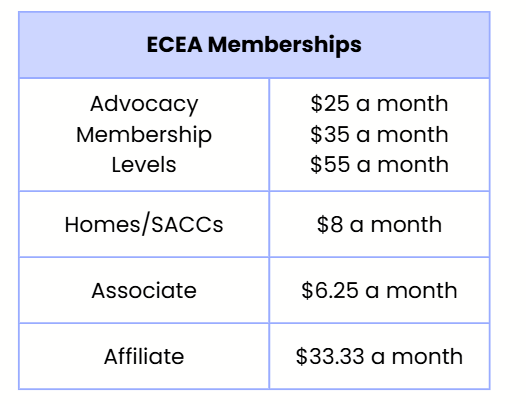
Join ECEA Now and Make a Difference!
https://eceaco.mykajabi.com/join-ecea-today
Want to see what a membership can potentially save you? https://www.coloradoecea.org/membership-savings-earnings

Responses