
HB26-1222 KILLED by Committee Under Pressure from the Governor!
HB26-1222 was killed by the Senate Finance Committee on May 12, 2026. It did not lose because of a vote. It was pulled before it even got that far. Senator Kathy Kipp, a Fort Collins Democrat, asked the committee to postpone it indefinitely after it became clear the Governor would veto it. The Governor's condition for signing it? Use some of the revenue to cut the state income tax. Senator Kipp called that irresponsible. And so the bill died.
That tension is important. It tells you that even within the same party, there is a real fight happening right now over what Colorado does with money. HB26-1222 was one casualty of that fight. It will not be the last.
SB26-135: Now Heading to Your Ballot in November
The same day HB26-1222 was shelved, SB26-135 passed the legislature and is now headed directly to the November 2026 ballot. No governor signature needed. It passed 42-21 in the House and 23-12 in the Senate. Not a single Republican voted for it.
Senator Cathy Kipp, the same lawmaker who killed HB26-1222 hours earlier, is one of SB26-135's main sponsors. She called it irresponsible to let taxpayers keep money through an income tax cut. She then helped send a measure to voters that would take $7,381 from each taxpayer's TABOR refunds over the next ten years.
Colorado voters will now decide in November whether to give up those refunds, permanently.
What SB26-135 Actually Does
TABOR, the Taxpayer's Bill of Rights, limits how much the state can collect and spend each year. When the state takes in more than the cap allows, it must refund the excess to taxpayers.
Coloradans have been asked to give up those refunds five times: in 1998, 2011, 2013, 2019, and 2023. Each time, voters said no. The 2023 vote, Proposition HH, failed by a wide margin.
SB26-135 asks for a sixth vote.
If it passes, the state's TABOR cap would increase by an amount equal to Colorado's annual K-12 spending, currently about $4.6 billion. Any revenue above the existing cap would be kept by the state instead of returned to you.
The money would be distributed this way. First, at least a 2% increase over the prior year's K-12 spending must be funded, about $107 million in year one. At least half of all surplus kept by the state in a given year must go to K-12 schools. Whatever remains after that would go to "other programs benefiting kids," and the bill specifically names early childhood initiatives, preschool access, and child care.
The bill was narrowed as it moved through the Capitol. Earlier versions gave the legislature broad discretion to spend leftover money on anything it wanted. The final version tied the remainder to children's programs.
Lead sponsor Sen. Jeff Bridges says "every dollar goes to kids." That is the message you will hear between now and November.
What "Early Childhood" Funding Has Actually Meant for Private Providers
Our industry's name is on this bill. That is not an accident. It is a strategy.
But before you take that as good news, consider what government-funded early childhood programs in Colorado have actually delivered for private providers.
CCCAP, the state's child care assistance program, has been frozen to new enrollees. Families who need help cannot get in. Providers who serve low-income families cannot count on it as a stable revenue stream.
UPK, Colorado's universal preschool program, doubled the number of four-year-olds in the public school system. That sounds like a win. But for community-based providers, it meant thousands of children were redirected away from private child care businesses and into publicly run programs. That is not a partnership. That is competition.
The money in SB26-135 designated for early childhood would flow through state-controlled programs and distributions. There is no language in the bill that requires any of it to support privately owned child care businesses specifically. Even today, CDEC is working to decrease ratios for UPK providers that are operating at ratio levels that they’ve been at, safely, for decades.
What This Costs Your Customers:
This matters from another angle too.
TABOR refunds go back to taxpayers. Those taxpayers include the parents who pay private child care tuition. When that money stays in their pockets, some of it finds its way to your center. The fiscal analysis on SB26-135 shows every taxpayer would lose $7,381 over the next decade if this passes.
That is real money leaving the households of your current and potential families.
And it will not happen overnight. The governor's office estimates the state will exceed the existing cap by about $711 million in the first year. But the full impact of the expanded cap may not be felt for ten years or more. This is a long-term shift in how Colorado collects and spends money.
The Graduated Income Tax ot "Fair Tax" or "Progressive Tax" or "Wealth Tax" Is Still in the Picture
SB26-135 is not the only TABOR-related push this year. A separate effort called Fair Tax Colorado (https://bellpolicy.org/fair-tax-colorado/) is pursuing a citizen initiative for the same November ballot. That measure would amend the state constitution to create a graduated income tax, raising rates significantly on individuals earning over $1 million while lowering them for those under $500,000. Supporters say it could raise $2 to $4.1 billion annually.
That measure still needs roughly 125,000 voter signatures by August 3 to make the ballot. That is a high bar, and it is not guaranteed. But it is being pushed hard by progressive groups, and it would compound the financial pressure on the Colorado households that support your business.
The states that have gone farthest down this road offer a clear data point. California has lost a net 1.63 million residents. New York has lost about 1.76 million. The luxury housing market in Colorado is already signaling stress: too many million-dollar homes, not enough buyers, more leverage for those who can leave. Migration between states accounts for about 11 percent of population movement in the U.S. When wealthy residents leave, they take their full tuition checks with them.
Three Questions That Need Answers Before We Vote
If this ballot measure moves forward, here is what we need to know before anyone asks private providers to support it.
First: What will this money actually do for early childhood before we vote? Not promises. Not projections. Specific commitments, written down, with accountability built in.
Second: Will the first priority be to cover the property tax burden on private child care owners? Right now, private providers pay property taxes that publicly funded programs do not. That is not a level playing field. If new revenue is going to fix early childhood, fixing that inequity should come first.
Third: How will a third government program succeed where the first two have not? We already have CCCAP and UPK. Both have hurt private providers in different ways. What is the specific plan to make this one different?
What You Should Be Watching
The death of HB26-1222 is a signal that tax policy in Colorado is going to be a major fight in 2026, and private child care is directly in the middle of it.
When the state funds early childhood, it does not automatically fund you. History has shown it can do the opposite. ECEA and our members will work proactively to ensure that any funding support truly helps mixed delivery. The critical way to prove that funding will support mixed delivery? Pay private child care providers’ property taxes. Tie it to a quality rating the way Florida has, JUST DO IT! Without that, private programs will always be operating at a fiscal disadvantage. Anything but that is lip service.
ECEA's Board is researching government funded programs worldwide to determine the impact on private industry and mixed delivery. We will be sharing out what we learn over the summer!
Take a Walk and Listen to Testimony About SB26-135 Bill Directly--Be Informed and Decide Where You Stand.
2nd Senate Reading for context - https://www.youtube.com/live/WOMMHtMUckM Time stamp 1:53:01
Final Bill - https://leg.colorado.gov/bill_files/116248/download
Final Fiscal - https://leg.colorado.gov/bill_files/116264/download
ECEA will be here advocating for your program and business regardless of how this turns out with the voters.
Read a Letter about CCDF Changes from Alex J. Adams, the Assistant Secretary for the Administration for Children and Families (Click Here).
ECEA is Bringing Innovative Health Solutions to CO Child Care....and you DON'T have to be a member to get it.
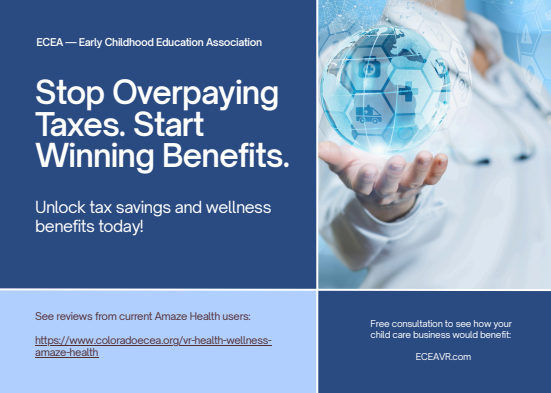
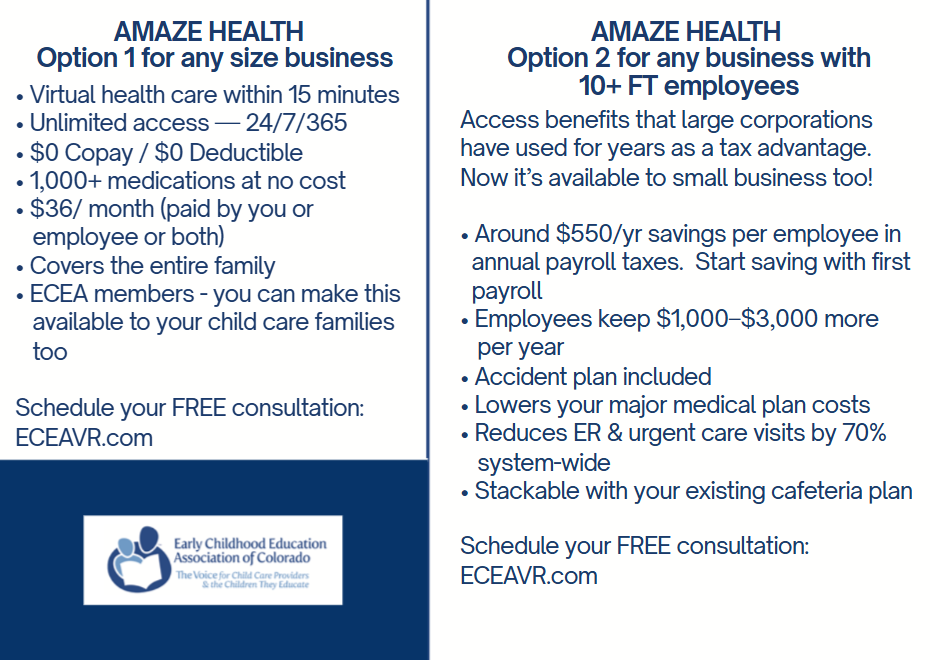
Drive down your major medical costs as you decrease urgent care and emergency room visits by up to 70%. If you have 10 or more full time employees, you actually SAVE on taxes and that generates more revenue for you and your staff! Let us know you are interested (no obligation) at ECEAVR.com and Dawn will reach out to give you all of the details and to connect you with the right people!
ECEA Members Minute
Member's ONLY content this week. You may have noticed that our member only site now looks like our public facing site...that's because we have moved our domain to that member only site. For the general public, they will go to www.coloradoecea.org and will see what they've always seen. YOU will be able to log into that site and go to the library page under your profile. That page will be your menu and will take you to any members only page you want to go to! This is just one more way that we are using your member dues more efficiently and making things easier to access!
Just a note: Our email was down for about 16 hours on Tuesday-Wednesday. If you did not get a response to an email you sent, please send again as we never got it. Thanks!
This week:
- Meet our NEW Board members
- Find out about new changes to the ECPC (CDEC is making inspections and renewals easier!)
- ECT Higher Education Apprenticeship Opportunity
- Legislative Session is over...see the final outcomes.
- NEW CCDF Regulations
Join ECEA Now and Make a Difference!
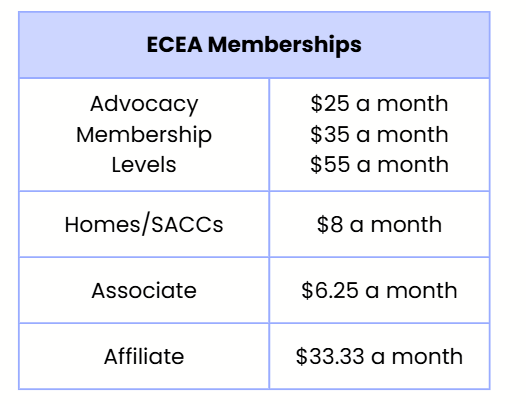
https://eceaco.mykajabi.com/join-ecea-today
Want to see what a membership can potentially save you? https://www.coloradoecea.org/membership-savings-earnings

Responses