|
Measure What Works for Kids
A better path than cutting preschool ratios
Policy brief · Early Childhood Education Association of Colorado · June 2026
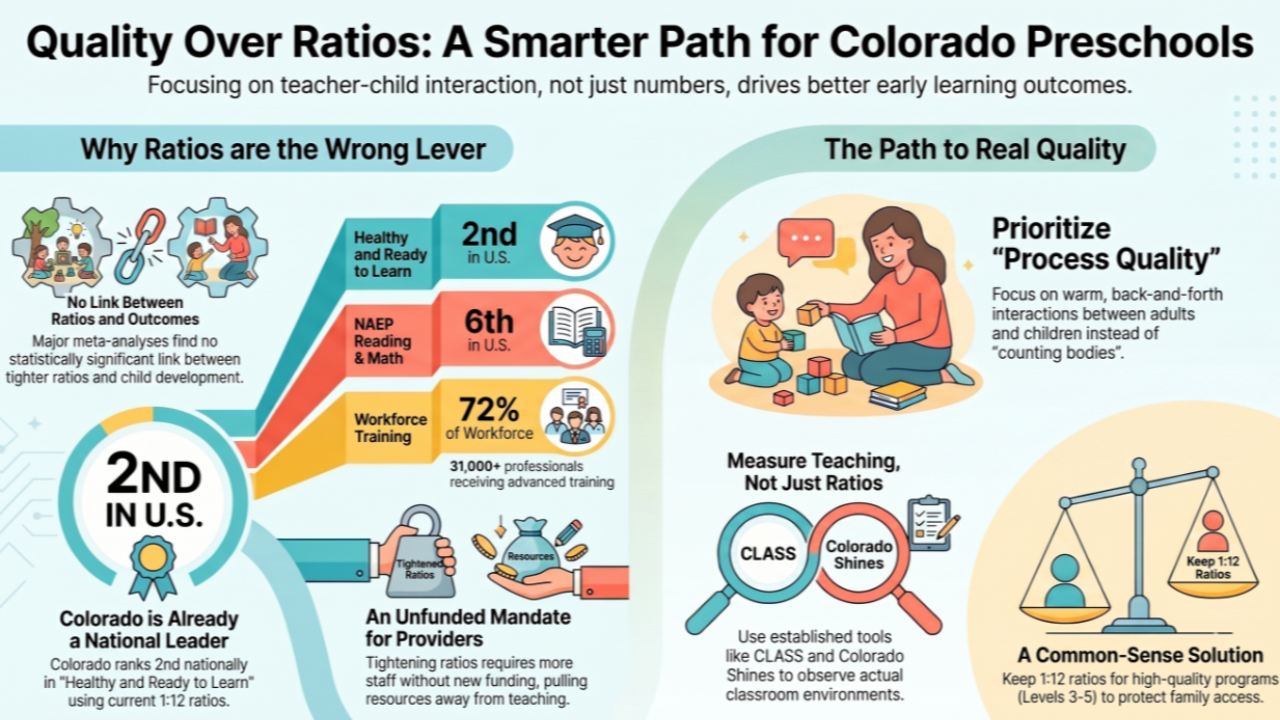
The bottom line. Colorado does not need to cut preschool ratios to raise quality. The research is clear that what drives children’s learning is the quality of teacher-child interactions — not small changes in ratios. Colorado already measures that through Colorado Shines and on-site observation. We urge the Governor to direct CDEC to keep our long-standing 1:12 ratio and measure UPK quality the way leading national systems do: by observing teaching and tracking children’s outcomes.
Ratios are the wrong lever
CDEC’s rule would push educator-to-child ratios below Colorado’s long-standing 1:12 — toward 1:11, and the goal of 1:10 — with no new funding to pay for the added staff. That is a heavy cost for providers. And it buys a change the evidence does not support.
What the research actually says
Researchers split preschool quality into two kinds. Structural quality is the easy-to-count part: ratios, group size, and credentials. Process quality is what actually happens between adults and children — warm, rich, back-and-forth interactions. Decades of research find that process quality is what moves children’s learning. Ratios help only indirectly, by making good interactions easier.1
When researchers test ratios directly, the effect on children is small and unproven. A 2017 systematic review and meta-analysis in PLOS ONE found no statistically significant link between staff-child ratios and children’s outcomes.2 A 2022 Campbell systematic review concluded it is “not possible to draw any definitive conclusions” about the impact of ratio and group size on children.3
In short: tightening an already-reasonable ratio is not where quality comes from — and it pulls money away from what does work.
Colorado already tested “more inputs”
Colorado has already tested the idea that more money and more inputs mean more quality. Since 2021, the state has invested over $465 million in federal pandemic-relief funds in the child care system.11 Even so, measured quality moved only modestly. The lesson is not that Colorado must now add a costly structural mandate like a tighter ratio. It is that money and inputs alone do not raise quality. NIEER itself calls its benchmarks a “minimal floor,” not a measure of what happens in the classroom.12 The lever is the quality of teaching — and that is where any new dollars belong.
How leading systems measure quality instead
The country’s most respected systems do not chase ever-tighter ratios. They measure teaching:
-
CLASS (the Classroom Assessment Scoring System) — required in every Head Start program since 2007 — scores the quality of teacher-child interactions in three areas: emotional support, classroom organization, and instructional support.4
-
Environment Rating Scales (ERS / ECERS-3) — observation tools used in state quality systems nationwide.5
-
NAEYC accreditation — built around relationships, curriculum, and teaching, and verified by observation.6
These are the real national best practices for judging quality. They look at what teachers and children do — not just how many bodies are in the room.
Colorado is already built for this
Colorado does not need to start over. Colorado Shines, our quality rating system, already rates programs using Environment Rating Scale observations.5 The UPK rule itself calls for an on-site observation of each classroom’s environment at least every three years.7 And the UPK statute tells CDEC to set standards for instructional practice and to reflect national AND community-informed best practices.8 Measuring interactions and outcomes fits the statute better than a ratio number does.
Colorado is also investing in the real driver of quality — its teachers. Through the Governor’s workforce initiatives, more than 31,000 early childhood professionals (about 72% of the workforce) are now receiving additional training, up from roughly 16,300 in 2023.13 That is the lever that raises quality: better-prepared, better-supported teaching. Expanding the workforce investment — not cutting ratios — is how Colorado leads.
And the current system is producing top-tier results. Colorado ranks 2nd in the nation — 3rd if you count D.C. — on the Healthy and Ready to Learn measure for young children.9 On the 2024 Nation’s Report Card (NAEP), Colorado ranks 6th in the nation across 4th- and 8th-grade reading and math, and outperforms the national average on most assessments.10 Colorado is getting these results with the 1:12 ratio we have now. Cutting it risks a system that is already working.
A solution CDEC can adopt now
There is a clean, ready-to-use fix. CDEC can issue an emergency rule that ties ratios to quality level:
-
Programs rated Level 3-5 on Colorado Shines keep licensing ratios (1:12). Colorado has always defined high quality as Levels 3-5, and the current rule already lets Level 4-5 programs keep their ratios — this simply extends that to the full high-quality band.
-
Programs rated Level 1-2 sign a letter of intent to reach Level 3 by the end of the year, through CDEC’s existing provisional process.
This rewards quality, keeps the door open for every program, and protects family access — without forcing an unfunded staffing increase on programs that are already high quality. Colorado law already lets a provider take part while working toward a standard.8 It is a logical solution that supports both programs and families.
The ask
We ask the Governor to direct CDEC to:
-
Initiate the emergency rule above: Level 3-5 programs keep licensing ratios (1:12), and Level 1-2 programs commit by letter of intent to reach Level 3 this year. No across-the-board cut to 1:11 or 1:10.
-
Measure UPK quality through observation of teacher-child interactions (such as CLASS or the Environment Rating Scales already used in Colorado Shines) and through children’s outcomes.
-
Invest any new quality dollars in coaching and teaching supports — the proven driver of results — instead of an unfunded mandate to add another adult to every room.
This keeps Colorado aligned with true national best practice, protects the mixed-delivery system, and puts the focus where the science says it belongs: on the quality of what happens between teachers and children.
Sources
1 Process vs. structural quality, and the finding that structural features affect children mainly by improving process quality: Peterson & Elam, Observation and Assessment in Early Childhood Education (open text); ECEC quality and child-outcomes meta-analysis, 2023 (PMC10212181).
2 Perlman, M., et al. (2017). Child-Staff Ratios in Early Childhood Education and Care Settings and Child Outcomes: A Systematic Review and Meta-Analysis. PLOS ONE. Finding: no statistically significant association between ratio and outcomes.
3 Dalgaard, N. T., et al. (2022). Adult/child ratio and group size in early childhood education or care to promote the development of children aged 0–5 years: A systematic review. Campbell Systematic Reviews.
4 Office of Head Start, Use of the Classroom Assessment Scoring System (CLASS) in Head Start; CLASS required under the Head Start Act of 2007 (headstart.gov).
5 Environment Rating Scales (ERS/ECERS-3); Colorado Shines QRIS rates programs using Environment Rating Scale observations (coloradoshines.com; cdec.colorado.gov).
6 NAEYC Early Learning Program Accreditation Standards (naeyc.org).
7 8 CCR 1404-1-4.111(B) — on-site observation of environmental quality at least every three years, aligned with Colorado Shines.
8 C.R.S. 26.5-4-205 — quality standards must reflect “national and community-informed best practices” (1)(a) and must include standards for instructional practice (2)(g); the Department may let a provider take part while working toward a standard for a limited time (1)(b)(II).
9 Child Trends, National Outcome Measure of Healthy and Ready to Learn, based on the National Survey of Children’s Health (HRSA / Maternal and Child Health Bureau). Colorado ranks 2nd among states (3rd including D.C.) (childtrends.org).
10 2024 NAEP - The Nation's Report Card, grades 4 and 8 reading and math: Colorado ranks 6th in the nation and outperforms the national average on most assessments; 4th-grade reading 221 vs. 214 national (nationsreportcard.gov; cde.state.co.us, Jan. 2025).
11 Colorado directed $465M+ in American Rescue Plan Act and Child Care Development Fund relief to the early childhood sector, including about $281M (60%+) in stabilization, workforce, and tuition grants (Gov. Polis / CDHS news release, 2021; cdec.colorado.gov).
12 NIEER, State of Preschool Yearbook (2023; 2024) - benchmarks are a minimal quality floor, not a measure of classroom quality; Colorado meets 2 of 10 (nieer.org).
13 Office of Gov. Jared Polis / CDEC, “Investing in Colorado’s Future”: 31,000+ early childhood professionals (about 72% of the workforce) receiving additional training, up from 16,321 (2023) and 19,325 (2024).
link to policy pdf: https://docs.google.com/document/d/1vK6gy8ZxTqY_U7cMrZTr6C1s2-ffBqED4Z2TEKcKOqY/edit?usp=sharing
|