
ECEA CHILD CARE UPDATE | ADVOCACY EDITION
One in Four Private Programs Closed in Three Years. Colorado, We Have a Churn Problem.
More than 1,000 Colorado child care programs closed between 2023 and 2026. The rest of the country held steady. This week we show you the real numbers, who is closing, who is rebuilding, what your own survey answers add, and what the state should be measuring instead of counting seats.
Start with what your business already knows
You do not need a report to tell you the last three years were hard. You lived it. Enrollment shifted. Rules kept coming. Costs went up. Some of your friends in the field closed their doors.
What you may not know is how different Colorado looks from the rest of the country. We pulled the state's licensed facilities reports from June 2023 and July 2026 and matched every program by license number. Resident camps are left out so the numbers reflect year-round child care and preschool. Here is what we found.
The Colorado numbers
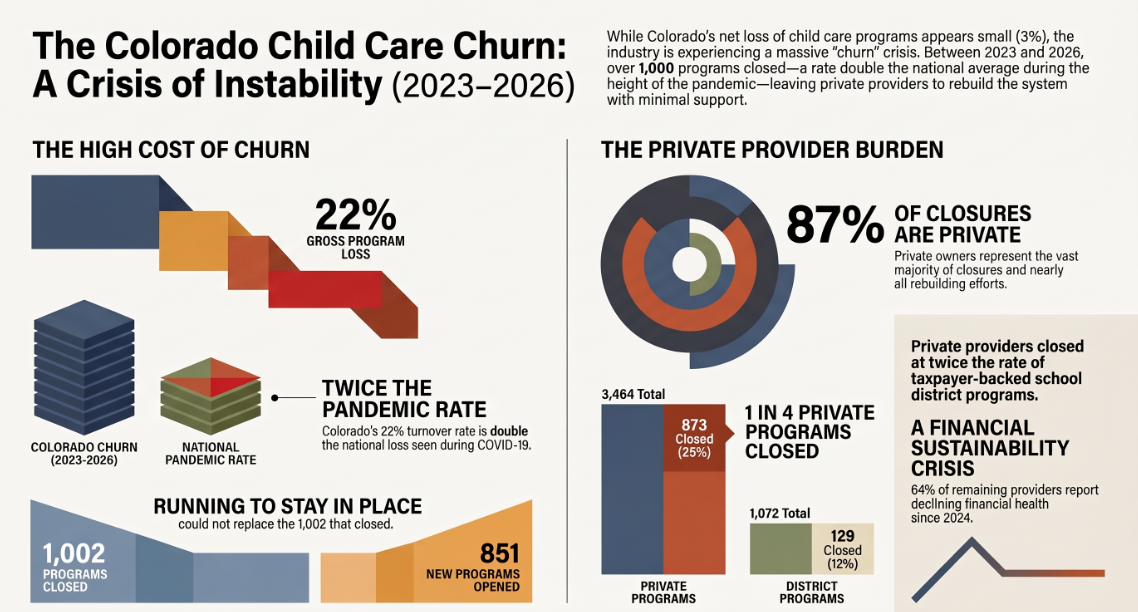
In June 2023, Colorado had 4,536 licensed child care programs. In July 2026, it had 4,385. That is a net loss of 151 programs, or about 3%.
The net number hides the real story. 1,002 programs on the 2023 list are gone. That is more than one in five (22%). 851 new programs opened to replace them. Colorado is running hard just to stay in place.
|
Colorado, June 2023 to July 2026 |
Number |
|---|---|
|
Licensed programs, 2023 |
4,536 |
|
Programs closed |
1,002 |
|
New programs opened |
851 |
|
Licensed programs, 2026 |
4,385 |
|
Net change in programs |
minus 151 (minus 3.3%) |
|
Share of 2023 programs that closed |
22% |
|
Licensed seats, 2023 |
241,281 |
|
Licensed seats, 2026 |
245,673 |
How that compares to the nation
Child Care Aware of America tracks licensed supply in every state. Their last two reports show a country that has stabilized. Licensed centers grew 1.6% from 2023 to 2024, then slipped 1% from 2024 to 2025. Family child care homes grew 4.8%, then 1.4%. Add it up and the national count of licensed programs is flat to slightly up over the same three years Colorado lost ground.
No national source publishes gross closures the way we just did for Colorado. The closest benchmark is the pandemic. From December 2019 to March 2021, the worst 15 months the industry has ever seen, the nation lost about 16,000 programs, roughly 9% of supply. Colorado just turned over 22% of its programs in a period with no pandemic and no relief cliff.
Colorado also ranks as the sixth least affordable state for child care and the sixth most regulated state for business overall. Those three facts belong in the same sentence. High cost, heavy rules, and high churn are not three problems. They are one.
Who is closing? Mostly you.
This is the number every lawmaker in Colorado should hear. Of the 1,002 programs that closed, 873 were privately owned. That is 87% of closures. Only 129 were run by school districts.
Now put that against the starting line. In 2023, Colorado had 3,464 private programs and 1,072 district programs. One in four private programs closed (25%). About one in eight district programs did (12%).
Private programs closed at twice the rate of district programs. Same state. Same families. Same rules. One side pays property tax and earns every dollar. The other has a taxpayer backstop. The results show it.
Family child care homes took the hardest hit. 414 homes closed and 295 opened, a net loss of 119 homes. Homes are the smallest businesses in our field and often the only option for infants, odd hours, and rural families. Not one of those 414 closed homes was a district program. Every one was a Colorado family running a business from their own house.
The pain is not spread evenly. Mesa County lost 38% of its programs. Larimer County lost 26% and ended 45 programs short of where it started. Denver ended 36 programs short. In Eagle, La Plata, and Fremont counties, roughly one in three private programs closed. Rural and resort Colorado is losing choices fastest.
Who is rebuilding? Also you.
Here is the part of the story nobody tells. Of the 851 new programs that opened, 778 were privately owned. That is 91%. Districts opened 73.
Private owners closed 873 programs and opened 778. Private owners are doing nearly all of the closing and nearly all of the rebuilding, and they are doing it with their own money, their own credit, and their own risk. Even preschool programs, the one category that grew, grew because private owners opened 49 new ones. Districts opened 31 and closed 27.
That is what a healthy industry looks like when it is given room to breathe. Owners step up where families need them. The problem is not that private owners will not open programs. The problem is how many cannot keep them open.
Your survey answers tell us why
The state data tells us how many doors closed. Your answers to our Walk It Forward survey tell us what is happening behind the doors still open. Here is what 160 programs have told us so far.
Two out of three (64%) say their financial health declined over the past two years. One in five (20%) have seriously considered closing. More than half (56%) say their 4-year-old enrollment has dropped since Universal Preschool (UPK) launched in 2023, and another 13% have UPK children who leave after the funded hours instead of staying the full day.
Ask about the next step, and the answer is nearly unanimous. If no-tuition district care expands to toddlers and younger children, 64% say it could threaten their ability to stay in business, and another 16% say it would create significant financial pressure. That is 8 in 10 programs telling us the next expansion is the one that closes them.
The paperwork is real too. More than 4 in 10 (42%) spend over 5 hours a week, per site, just on UPK and Colorado Child Care Assistance Program (CCCAP) requirements, beyond what licensing already asks. One in four spend more than 10 hours. Public funding is a net cost for about half of the programs that take it (22 of 45), once the paperwork is counted.
And every single respondent, 45 out of 45, said it is essential that private providers help design any new funding system before it is built. Not a single "nice to have." Essential.
Why churn is the number that matters
Every closure is a small business lost. It is also a family who has to start over, a child who loses the caring adult they knew, and a neighborhood with one less choice. When 1,002 programs close and 851 open, families do not see "net minus 151." They see disruption, twice.
Churn also tells you what happens next. When smaller programs close and larger programs replace them, options narrow. When homes close, infant care and off-hours care get harder to find. When rural counties lose a third of their private programs, the choice for a family starts to look like one choice.
We saw this happen with UPK. It created seats and moved children. It did not create more families. Nearly half of centers reported lost revenue, and many lost 10% to 80% of their enrollment. Colorado already ran the experiment on what happens when you build new public seats into a market that already has empty ones.
What Colorado should measure
Right now the state measures inputs: seats created, dollars spent, quality ratings earned. None of those tell a parent whether their program will still exist next August. ECEA recommends the state track four outcomes instead, and publish them every quarter or twice a year at a minimum:
-
Churn. Programs closed and opened, by county and by ownership type (private, nonprofit, district).
-
Occupancy. Enrolled children as a share of licensed seats. If seats grow and occupancy falls, the state is building into empty rooms.
-
Continuity. How many children stay in one program from infancy to kindergarten.
-
Dollars to programs. How much of each public dollar reaches a classroom versus paying for oversight.
Once those numbers are public, every idea on the table can be tested with one question: does it fill existing seats, or empty them? A new tax structure, a new way to use federal child care funds, a new local measure, more preschool money. Same test, every time. That is the cheapest way Colorado has to lower churn, and it does not cost taxpayers a dime.
What you can do this week
Take the survey if you have not yet. It is anonymous, it takes about five minutes, and it is still open. Every answer makes the case stronger when we sit down with the SB26-020 task force, the Colorado Department of Early Childhood, and the people writing the next funding measure. Take the provider survey here. If you are a member you can find your unique link in the Insider’s Edge. We want every private program in Colorado counted.
Share these numbers with your families. Parents choose you for continuity and trust. Tell them what is happening to the choices in their community.
Share them with your county commissioners and your state legislators. Ask them the occupancy question. Most have never heard it.
And keep your doors open. That is the most powerful advocacy there is. ECEA exists so no owner has to face the rules, the funding shifts, or the state alone. The 3,393 private programs operating in Colorado today are the backbone of this system, and they are rebuilding it every day. We are in your corner, and we are speaking up while private industry is still here.
Sources: Colorado Department of Early Childhood, Licensed Child Care Facilities Report (June 22, 2023) and Monthly Facilities Report with Contacts (July 2026); ECEA analysis matched by license number, resident camps excluded. ECEA Member Survey, Walk It Forward, 45 member responses as of September 8, 2026 (survey still open). Child Care Aware of America, Child Care in America: Price and Supply, 2024 and 2025 editions, and Demanding Change (2022) for pandemic closures. The 74, "A Child Care Paradox: Families on Waitlists, Centers Underenrolled." Center for American Progress, "Measuring America's Licensed Child Care Supply" (methodology). Colorado Newsline, January 14, 2026 (affordability ranking). StratACUMEN and Colorado Chamber, 2024 regulation study.
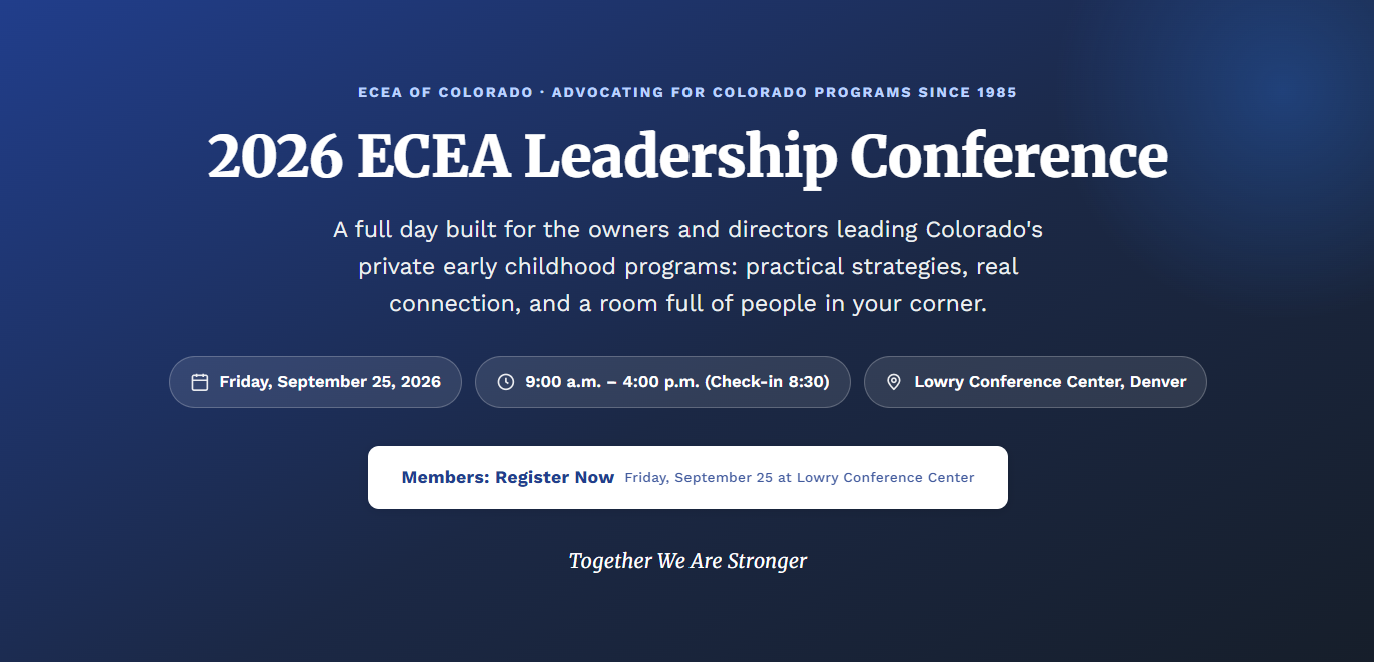
TIME IS RUNNING OUT!! Register today!!
https://www.coloradoecea.org/ecea-leadership-conference
Pro members, email who is coming to [email protected]
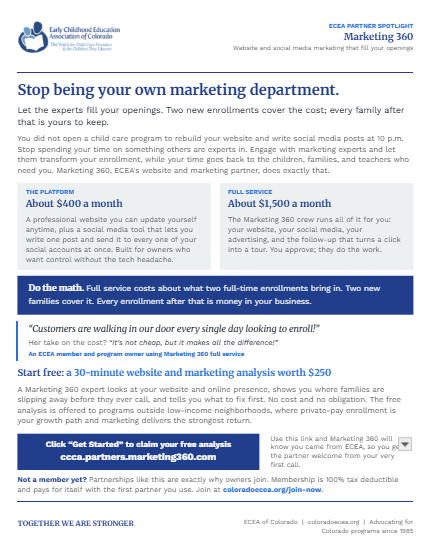
This works best if you are not in a low income family, heavily or completely reliant on CCCAP funding. If you are anywhere else this can be a huge help! Do a free consult and find out how and why.
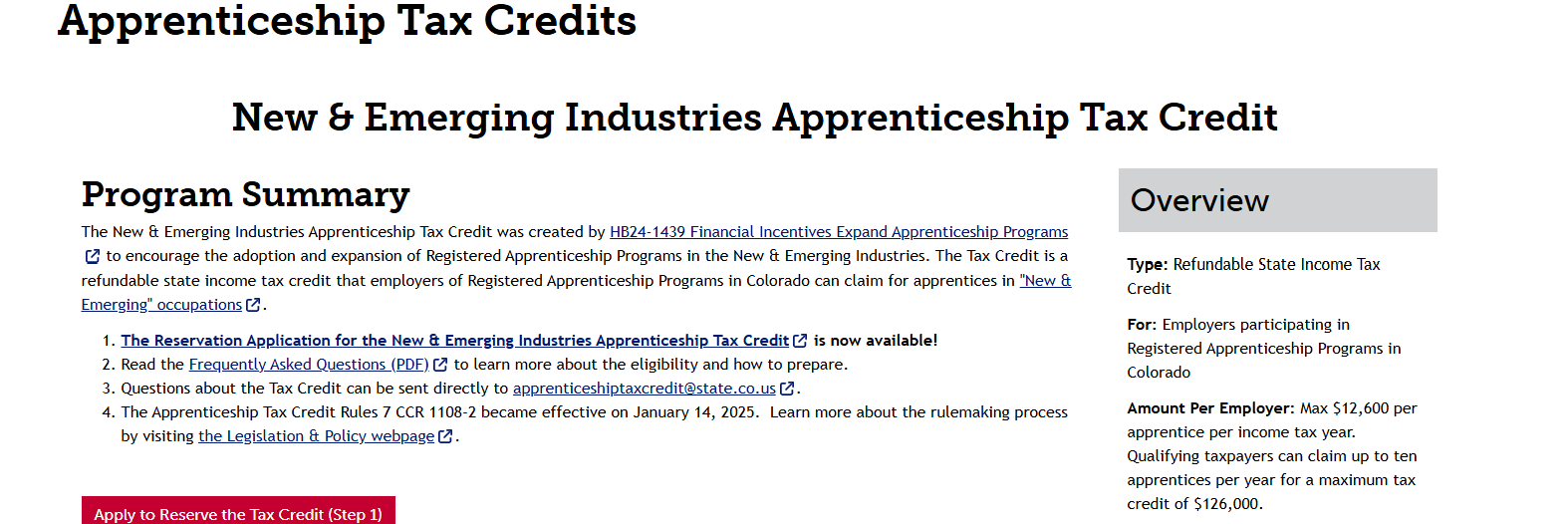
Have you Pursued This Tax Credit?
https://apprenticeship.colorado.gov/tax-credit
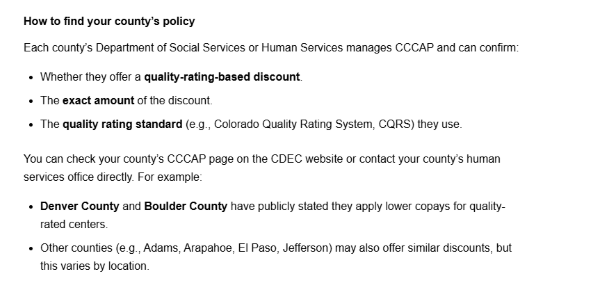
We Need to Know---is your County paying the Rating Discount Credit or are they Passing the Burden to you??
We ask because 1) CDEC has $27 Million sitting in their bank account. 2) If they offer an incentive, they should not cut into the base payment to providers as they are only paying you 75% of the market rate in your community to provide this care. 3) If they are passing this discount fee to you to absorb, we need to make sure the federal government is aware of this caveat and want to make legislators and the general public aware.
Email [email protected] to let us know!! Please simply by telling us your count so we don't have to reference our membership list!
Survey Says....
Here are our member responses. We are also breaking the data out based on membership, non-membership, and combined in the coming weeks.
https://www.coloradoecea.org/walk-it-forward-survey
THANK YOU FOR BEING A MEMBER!! YOU MAKE A DIFFERENCE EVERY DAY IN THE CO CHILD CARE INDUSTRY!!

Responses