Every Rule Removes a Hedge
Why the real cost of child care regulation is the options you are no longer allowed to offer
A question came up recently in a conversation about Colorado child care rules. It went roughly like this: complying with Rules has an associated cost. What are the rules that cost you to comply with, and what is that cost?
It is a fair question, and it deserves a real answer. It also reveals something important. When the people who write the rules believe the only cost of a rule is the price of the thing it mandates, every new rule looks free. That belief is the quiet assumption underneath most of the regulatory growth you have lived through. So let's answer it honestly, because the answer is bigger than a fee schedule, and because we have already done the work.
First, a word borrowed from finance: the hedge
We are currently reading Sustaining Capitalism, a 2017 book from the Committee for Economic Development, a nonpartisan group of business leaders. One passage on the financial sector stuck with us. It says innovative products and services do two things for an economy:
1) they boost liquidity (money & resources can move where they are needed)
2) and they hedge risk.
If you have never worked in finance, here is what a hedge means in plain terms. A hedge is anything you do so that one bad event does not take down your whole operation. A farmer who grows two crops instead of one is hedged; a drought that ruins the corn may spare the beans. A family with two incomes is hedged against one layoff. The principle is simple: risk is manageable when the things you depend on do not all fail at the same time, and dangerous when they do.
A child care business hedges the same way. A center with a tuition-paying infant room, a Universal Preschool (UPK) classroom, a few Colorado Child Care Assistance Program (CCCAP) families, a school-age summer camp, and a half-day enrichment option is diversified. When UPK payments land 45 days past servive, the infant room covers payroll. If CCCAP enrollment dips, summer camp fills the gap. If a family wants drop-in care or an extended day, you can say yes and charge for it. Each distinct offering is a hedge against the failure of another.
Every uniform requirement removes one more way a provider can protect herself. We are not spreading risk across the system; we are stacking it on the owner.
What a rule really costs: we already did the math
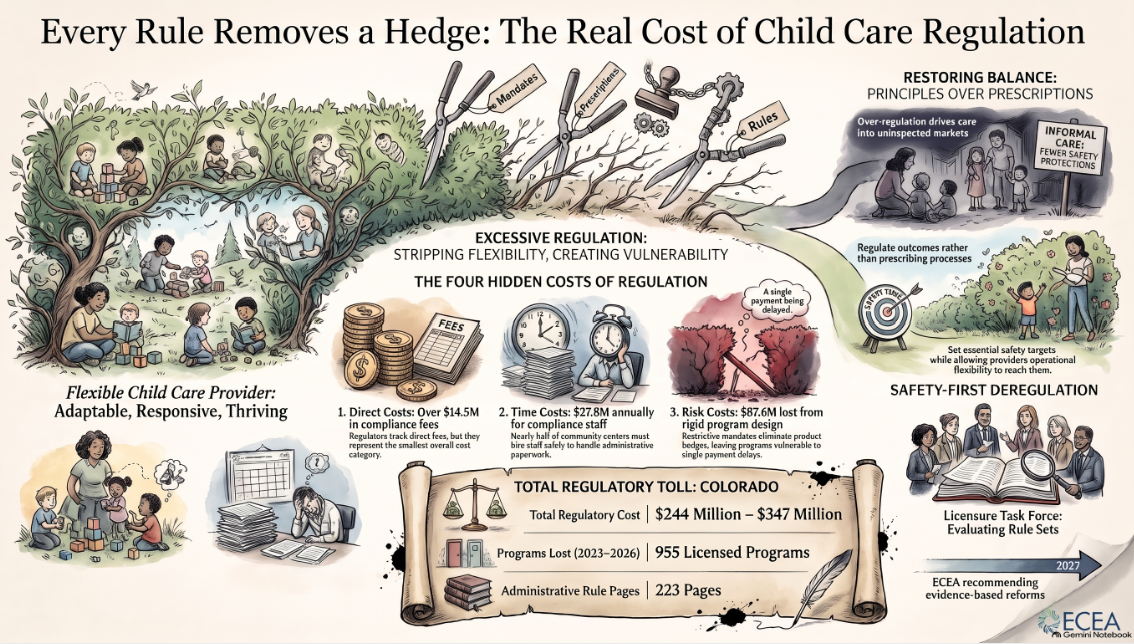
Here is the part of the question that matters most. ECEA answered it in December 2024. Our white paper, The Breaking of an Industry, priced the combined impact of administrative, state, and federal policy decisions on Colorado's community-based child care programs at $244 million to $347 million every year. The calculations are public, the sources are linked, and the paper went to the state the week it was published. So the real question is not whether the cost has been calculated. It is why the number keeps getting treated as if it does not exist.
A rule costs a program four things, and only the first one ever shows up in a fiscal note. Our numbers fall into all four.
-
The direct cost. The fee, the fence, the training registration. Under the previous Colorado Shines rating system, getting rated ran an average of $10,052 per program, about $14.5 million across the state's rating goal, and another $10.5 million in quality improvement support was cut from the state budget and shifted onto programs. We hope the new rating system does better. A large program has to pay on average $6,500 a year per program to have their staff take PDIS trainings. Monthly staff meetings cost about $18,000 year. Costs are everywhere! This is the category regulators calculate, and it is the smallest of the four.
-
The time cost. Nearly half of community-based centers and preschools have had to hire staff just to manage compliance, at an average of $41,071 per program, about $27.8 million a year. Staff name compliance and rating requirements as major reasons for leaving the field, and replacing them costs another $19 million a year in onboarding, even after we cut that figure in half to allow for every other reason people leave.
-
The design cost. When a rule dictates how a program must be built, it decides what you are allowed to sell. The mandated Universal Preschool (UPK) ratio change costs programs $43 million to $111 million a year, because a classroom built for twelve cannot refill to twelve during the hours UPK does not cover. The shift of UPK slots from community programs into school districts cost another $22 million to $57 million statewide in a single year.
-
The risk cost. This is the one no fiscal note counts, and it is the largest. When Family and Medical Leave Insurance (FAMLI) kept newborns home six months longer, infant rooms lost an estimated $87.6 million in revenue with no offset, because infant care was the only product many programs were allowed to design around. Colorado Child Care Assistance Program (CCCAP) rates below market cost another $13.6 million in 2024. Each of these landed hardest on programs with the fewest hedges, and the rules are what took the hedges away.
Add it up and you get the $244 million to $347 million statewide annually. Then look at what happened next. Between 2023 and 2026, Colorado lost 955-1000+ licensed programs. Nearly nine in ten of them were private, community-based providers. New openings did not keep pace, and the state had to rebuild almost 40,000 seats just to stay even. A fully engaged center now follows 223 pages of rules before it opens its doors. A fee schedule cannot explain that. Concentrated risk can.
Risk should be hedged, not intensified
The book makes one more point worth carrying into Colorado. When a regulated sector is squeezed hard enough, innovation does not disappear. It moves outside the regulated space, where there is no transparency, no oversight, and no one watching. In child care, that means more license-exempt arrangements, more informal care, more families piecing together solutions no licensing specialist will ever inspect. Rigid rules do not eliminate the options parents want; they push those options to where children are least protected. That is a child-safety argument for flexibility, not just a business one. Funding FFN's is a potential liability risk for the state. One incident, one lawsuit, brings that to an end.
That is also where the "public option" conversation belongs. School districts that do not take federal low-income child care dollars are not bound by federal Child Care and Development Fund (CCDF) rules. Moved under the Colorado Department of Education (CDE), they could step outside the Colorado Department of Early Childhood (CDEC) and its ever-expanding rulebook entirely, and run a separate system of care for children birth to five with a fraction of the requirements private providers must meet. One publicly funded system grows while the private programs that hedge it carry the full compliance load. That is concentrated risk by design, and it is why the ECEA Board has voted to oppose Proposition NN: if it passes, school district funding rises by roughly 50 percent while private child care providers receive no guarantees, short term or long term. Few private programs can absorb that kind of fiscal pressure, and the families who depend on them should not have to find out.
None of this is an argument against rules. Ratios, safe sleep, background checks, and the high-risk activity standards protect children and should stay. The argument is about how we regulate. Sustaining Capitalism puts it well: set the outcome you need (safe, supervised, developmentally sound) and let the people doing the work choose how to get there, then measure results. Principles over prescriptions. That is how an owner keeps her hedges while the floor stays firm.
Where ECEA is taking this
ECEA holds a seat on the SB26-020 Child Care Licensure Task Force, which is charged with recommending safe deregulation to the General Assembly by January 1, 2027. We have gone line by line through all four Colorado child care rule sets and flagged several hundred provisions that exceed the federal floor without a direct safety purpose. We have the cost accounting. We have the closure data. What we are hearing from conversations like the one that sparked this article tells us the next job is making sure nobody in that room can say the cost is unknown.
We are in the room so you do not have to be. The strongest thing we can carry in with us is a number that is current, and that comes from you.
|
Help us bring the number up to date
Our white paper is nearly two years old. Reply to this email with one example in a sentence or two, and we will fold it into the task force record (anonymously unless you tell us otherwise). We will post responses on our Facebook page for all to see.
-
A rule that costs you staff hours every week, and roughly how many.
-
A program, schedule, or service parents asked for that a rule prevented you from offering.
-
A moment when one funding stream or payment delay hit your whole program because you had nothing else to lean on.
Read the full white paper and the calculations behind it at coloradoecea.org under advocacy/administrative advocacy. We elevate your voice.
|
TOGETHER WE ARE STRONGER
Early Childhood Education Association of Colorado | Advocating for Colorado programs since 1985 | coloradoecea.org