What MUST happen with the money
Colorado already has a child care system: thousands of licensed private centers and homes that families chose, that employ about 19,000 Coloradans, and that pay into the property tax base that funds the school district down the street. The Children's Account must strengthen that system, not stand up a second one beside it. Here is what must happen with the child care share, with Proposition NN and with every funding source that follows.
-
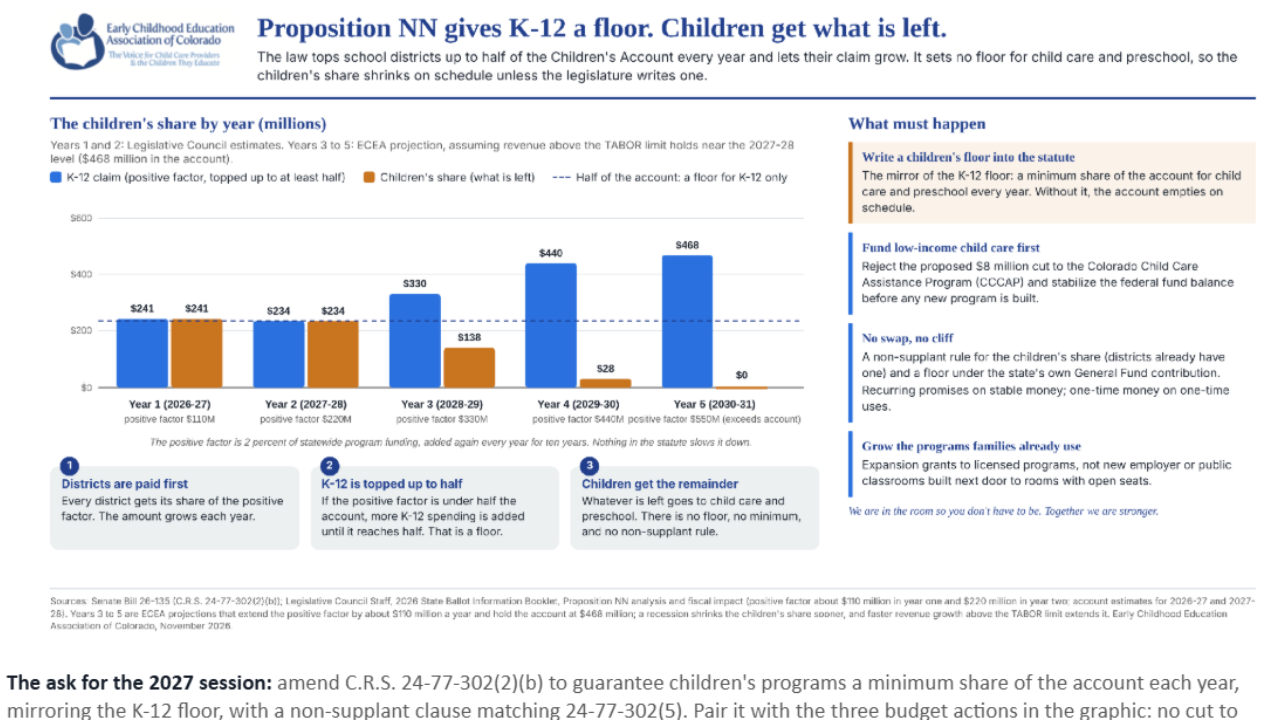
Fund low-income child care first: stop the cut, stabilize the base, then grow it. The Colorado Child Care Assistance Program (CCCAP) is the state's only subsidy for working families who cannot afford tuition, and it is capped, waitlisted, and under-reimbursed. It also runs on federal Child Care and Development Fund (CCDF) dollars that the state has been spending faster than they arrive: CDEC's own projection shows the fund balance going negative in 2028-29. The department's answer, in the budget request now in front of the Joint Budget Committee, is an $8 million cut to CCCAP this year. In the same request, the department asks for $7.3 million to build infrastructure for CLASS observations (the Classroom Assessment Scoring System used in Colorado Shines ratings). Read that again: the state proposes to take $8 million out of the slots working families use and put $7.3 million into watching classrooms. In the week voters approved a measure whose text says "prioritizing child care," that cannot stand. The first Children's Account dollars must erase the cut, keep the fund balance positive through 2030-31, and be locked in with a non-supplant rule (the same protection districts got) and a floor under the state's own General Fund contribution. Only then does new money go to rates, refreshed county income tiers (still built on 2019 data), and the waitlist, and those recurring increases must sit in the permanent base, not on a dollar that disappears in a recession year. Every CCCAP child is enrolled in a licensed program a family chose, so this is still the fastest, cheapest way to turn Proposition NN into slots. Every filled slot puts revenue in a provider's hands to build a quality program.
-
Let the dollar follow the child to any licensed setting. "Full-day preschool" cannot become a district-only program. Colorado's Universal Preschool (UPK) already proved that when families choose, community programs grow: four-year-old dollars follow the family anywhere, and community providers took all of last year's growth. Three-year-old dollars, by contrast, flow only through school districts, and those payments fell $7.8 million last year. Any preschool expansion funded by this account must pay the same rate for the same child in a licensed private program as in a school, including three-year-olds.
-
Fund expansion grants, not employer grants. We priced the seats. Three grant programs that built rooms and raised teacher pay in licensed programs, more than $12 million in one-time money, expire December 31, 2026, and the teacher wage pilot already ended in June after a positive evaluation. When the state replaces them, it must choose the cheaper seat. ECEA priced both from the department's own grant report to the Joint Budget Committee: the Emerging and Expanding grant created about 6,200 slots in existing licensed programs at roughly $2,300 in startup dollars per slot; the Employer-Based grant created about 1,800 slots at roughly $10,300 per slot in state money, and current licensed providers were not even allowed to apply. The same dollar buys four to five times as many seats in an expansion grant as in an employer grant. The difference is not only price. An expansion grant grows a program that already exists, with its staff, its families, and its place in the community. An employer grant places something new and shiny in that same community, built with public money, drawing enrollment away from the licensed programs that were already there. One strengthens the system; the other undercuts it. The Children's Account must fund a standing, provider-facing expansion grant and wage support every licensed program can reach, not a lottery for 19 of 74 eligible centers and not a second employer program that builds classrooms next door to programs with open rooms.
-
Pay providers the way the state pays everyone else. New money must not arrive on the old terms. Programs currently float UPK payments for weeks and absorb cuts when a child holds both a UPK and a CCCAP award. UPK pays 45 days in arrears in the name of accuracy, yet the payment still lands wrong for many programs and still has to be reconciled, which was the stated reason for moving to after-service payment in the first place. Private programs also carry costs a district never sees: FAMLI (Family and Medical Leave Insurance) premiums and property tax, to name two. Any program funded from the Children's Account must pay in the service month, pay on actual enrollment, and never reduce a provider's reimbursement because a child also holds a public award. CDEC can do better in how it serves providers, and a strong mixed-delivery system depends on it.
-
Report it like the districts have to. Proposition NN holds the two halves of the account to different standards. Starting August 1, 2027, every school district must post its actual positive-factor spending online, free, in a downloadable and sortable format, so anyone can see where each dollar went. The children's share gets only a line in the state auditor's annual report: how much was retained and a general description of how it was spent. Nothing requires the state to say which programs got the money, whether it reached district classrooms, community centers, or licensed homes, or which counties it landed in. The children's share must meet the district standard: dollars by program, by setting (district, community, home), and by county, posted annually. That record is what protects the share in future years, because it shows whether the money reached licensed programs families already use. What gets counted gets protected.
-
Do not spend it on a "public option." A 2027 bill is expected to propose studying a public child care option for children birth to five. The Children's Account must not become its down payment. School districts can already open infant, toddler, and preschool rooms today by licensing through the Colorado Department of Early Childhood (CDEC), under the same rules and with the same specialized support that keeps young children safe in every licensed program. Many do. A separate public system means public dollars building classrooms next door to licensed programs that have open seats, under fewer requirements, and the state's own figures show that school district slots are the most expensive slot on the menu. If a district wants to serve young children, the door is open: license with CDEC and compete on the same terms as everyone else.
-
Seat the people who deliver the care. Licensed private programs serve the majority of Colorado's young children in care. Wherever this money is designed, whether at the Joint Budget Committee, the Colorado Department of Early Childhood (CDEC), or any commission, private providers must be at the table in proportion to the care they deliver.
Why this matters to your business
Every one of these asks puts revenue into licensed programs that already exist: higher CCCAP reimbursement, preschool dollars you can enroll against, grants you can actually apply for, payments that arrive on time, and a public record that shows what your sector delivers. The alternative, a children's account spent on new public buildings and new agencies, pulls four-year-olds and three-year-olds out of the rooms that keep your infant and toddler classrooms open. Proposition NN did not decide which way this goes. Advocates will, and ECEA is already at work on where every dollar must go and how to keep it from undermining low-income child care, whether that dollar comes from Proposition NN or from any source that follows.
What advocates can do now
-
November and December: the Joint Budget Committee begins its briefings and hearings on the 2027-28 budget, including the department's request to cut CCCAP by $8 million while spending $7.3 million on assessment infrastructure. Email the six JBC members and your own legislators with one message: "The law says prioritize child care. No $8 million cut to CCCAP while $7.3 million goes to assessment infrastructure. Fund the slots families already use." Funding low-income child care is the larger issue, larger than building more quality inputs into UPK. Colorado does not yet have reliable data showing how children in each setting arrive at kindergarten; the state should review the data it has before it pours more money into quality machinery. And it does not need a new review process: licensing specialists already visit every licensed program and could review UPK operations for CDEC in the same visit.
-
December 20: Legislative Council Staff and the Governor's budget office publish the quarterly revenue forecast. This is the first official estimate of how much the state will keep above the TABOR limit this year, which sets the size of the Children's Account.
-
January 12, 2027: a new governor takes office. The $8 million CCCAP cut is in the outgoing administration's November budget request; the incoming governor can withdraw it through budget amendments in January. Ask for exactly that.
-
January 15, 2027: by statute, Legislative Council Staff (nonpartisan legislative staff, not the governor) determines the Proposition NN limit, the ceiling on what the state may keep. It is a cap, not the amount; the amount follows the forecasts and is certified by the state controller by September 1, 2027.
-
January session: bills will move to spend the account, and supplemental appropriations will set the current-year share. Hold every sponsor to the seven requirements above. ECEA will publish a one-page scorecard as bills are introduced.
-
February and March: JBC figure setting. This is where the CCCAP line and the children's share are decided for 2027-28.
-
January member snapshot survey: ECEA will ask impact questions. Real numbers from real programs are what move a budget line, and the survey puts them in ECEA's hands before figure setting.
We are in the room so you don't have to be. We elevate your voice. Together we are stronger.
Sources: Senate Bill 26-135 (enrolled); Legislative Council Staff, 2026 State Ballot Information Booklet, Proposition NN analysis and fiscal impact; CDEC Response to JBC Request for Information #8 (Sept. 1, 2026); CDEC UPK FY 2026-27 budget responses; Associated Press call, Nov. 3, 2026. Figures are state estimates and will change with actual revenue.
|