
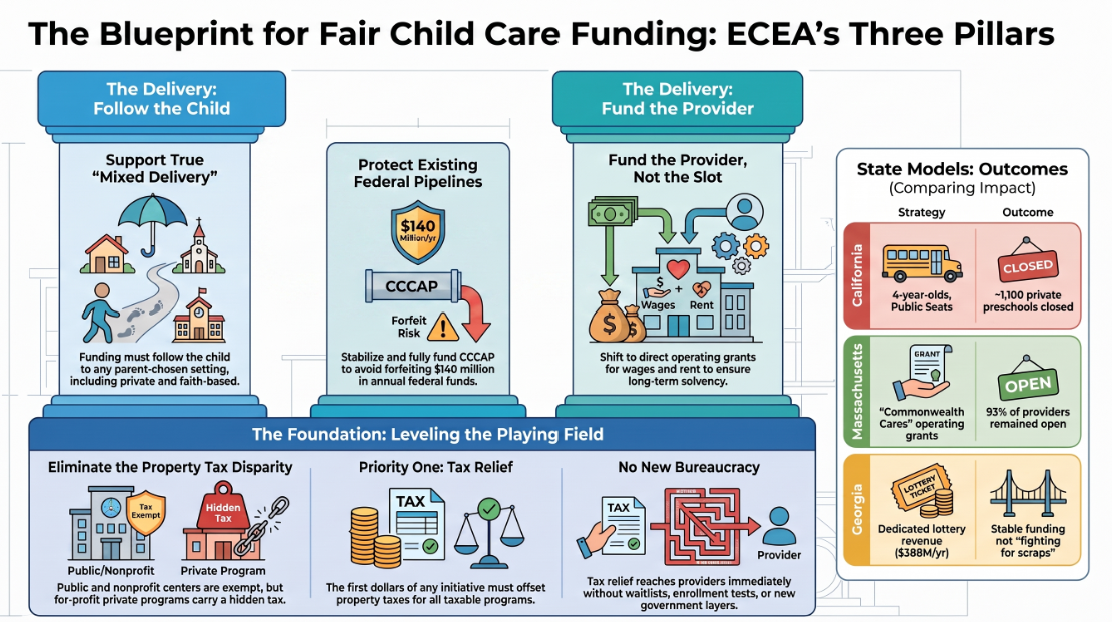
New funding is coming, statewide and locally. Whether it comes from a progressive tax, a sales tax, a lodging tax, or a special district, the dollars can strengthen private programs or quietly replace them. The difference is design. Before ECEA supports any funding initiative, we look for a specific set of requirements to be built in, and they matter in a specific order: level the playing field, follow the child, and fund the provider.
Start on level ground
Colorado already exempts public school districts and qualifying nonprofit child care centers from property tax. Licensed for-profit private programs are not exempt. They carry a tax their public and nonprofit competitors do not, usually buried in their lease, and that is a built-in cost disadvantage on the very businesses that anchor care for working families.
So the first dollars of any initiative should go to offsetting the property-tax burden of taxable private programs, reaching both owner-operators and the providers who pay it through rent. Every taxable program gets relief at once, with no waitlist, no new bureaucracy, and no enrollment test. The legal gap is real. Under C.R.S. 39-3-110, nonprofit centers are exempt and public districts are exempt as government, but for-profit licensed programs fall outside both. Level the playing field first; then build everything else on fair ground.
Why do we lead with this? It's fast, it's fair, and it's unarguable. We're not asking for advantage, only for the same treatment public programs already receive. Private programs are essential infrastructure, and any public investment should treat them as equals.
Follow the child
Funding should follow the child to the provider the parent chooses, including private, faith-based, and family programs. In practice that means full mixed delivery, with every dollar spendable wherever the family enrolls. It means keeping universal-preschool dollars usable inside private programs; when 4-year-olds are pulled into public-school seats, it strips the revenue that keeps infant and toddler rooms viable, the dynamic that closed roughly 1,100 private preschools in California.
It also means equalizing funding for 3-year-olds. Colorado still routes about $37.8 million in legacy Colorado Preschool Program money, plus a district-only “hold harmless” backstop, through school districts, so community programs can serve 3-year-olds only by subcontracting with a district. Direct, equitable 3-year-old funding keeps districts from pulling children away at age 3 with money private programs cannot match. Parent choice is the whole point, and money that can only be spent in one kind of setting is not really following the child.
Fund the provider, not just the slot
Colorado's system runs on flat federal money and a declining tobacco tax, and it pays per-slot instead of funding the provider. Massachusetts and Georgia solved the same problems with dedicated revenue and provider-direct delivery, and Colorado can too. That starts with a dedicated, growing revenue stream. Georgia's lottery brings in roughly $388 million a year and Massachusetts uses a dedicated surtax, so child care is not fighting for scraps every budget year.
From there, pay operating grants straight to programs for real costs like wages, rent, and supplies, so they stay solvent through the weekly enrollment swings that come with the work. Massachusetts's “Commonwealth Cares for Children” grants kept 93% of providers open. Preserve enrollment-based payments rather than reverting to attendance-based ones; paying on enrollment is the stability reform Colorado already proved works, with infant and toddler enrollment up about 6,000. And fund true-cost rates while actually appropriating for them, because otherwise higher rates simply mean fewer children served, the trap now freezing CCCAP in 21 counties.
Keep the funding, and the voice
Colorado's child care assistance program, CCCAP, is the pipeline that roughly $140 million a year in federal funds flows through to families and providers, and it must be supported and kept in place. Eliminating or replacing it would forfeit that federal money, money a state-run program would then have to backfill dollar for dollar. The smart move is to stabilize CCCAP and fully fund it, not trade it for a costlier, government-run system that puts those federal dollars at risk.
Finally, keep private providers at the table. Eligibility, rate formulas, and special-district governance are decided in rulemaking and board rooms, not just at the ballot box, and ECEA and it's hundreds of members needs to be in those rooms before any design hardens.
New investment in child care is welcome, but only when it is built to reach the private programs that families actually rely on. That is the test, and it follows one simple logic: Level the field first. Follow the child. Fund the provider.
Read alongside ECEA's companion brief, “When the Money Flows In, Does Private Child Care Survive?”, which documents the state-by-state evidence behind each requirement.
Sources: C.R.S. 39-3-110 and its 2022 expansion (CO Div. of Property Taxation); CO JBC FY2026-27 Early Childhood briefing; CDEC/CDE 3-Year-Old Preschool Program guidance (SB23-287); Bell Policy Center and Early Milestones Colorado; U.S. Chamber Foundation and GBPI (Georgia lottery Pre-K); Massachusetts Budget and Policy Center (C3 grants); EdSource and Hechinger (California TK). ECEA advocacy guidance, July 2026. Not tax or legal advice.
Together We Are Stronger. coloradoecea.org · We are the workforce behind the workforce.
Members Corner - Some Pro Members Have Resources to Share with other Members:
1) Interested in an app for job postings for about $500 a month? Larisa Hagenbarth at [email protected]
2) Trainings on how to support language development from a UNC Professor. tutelainstitute.com/courses
3) Stutris was built to help early childhood programs simplify enrollment planning, manage transitions more efficiently, and ultimately optimize both classroom capacity and revenue. It can make a meaningful difference for small and growing centers. Contact Astrid Koknke for details at [email protected] or submit the form at www.stutris.com
4) The Denver Early Childhood Council has a variety of trainings available for the child care industry. See their calendar at: https://denverearlychildhood.org/calendar/
Pro members, let us know if you have other resources that you want to get out to members! Email: [email protected]
You can find these details (and any more that members send in on our Members' Minute link in the www.coloradoecea.org login!

Responses