ECEA CHILD CARE UPDATE | ADVOCACY EDITION
Mixed Delivery Costs Money. Colorado Spends Less Than Two Cents on the Dollar.
The Colorado Department of Early Childhood (CDEC) says legislators have shown a commitment to building a mixed delivery system: public schools, Head Start, and private, licensed centers and homes all serving young children side by side. We appreciate the words. We went looking for the money. The state's own budget documents tell a different story, and every owner and director in Colorado should know the numbers before the next legislative session starts in January.
Where the money goes
Colorado's budget for the year that began July 1, 2026 is $49.6 billion. Here is how the two departments that serve children compare, straight from the Joint Budget Committee's summary tables.
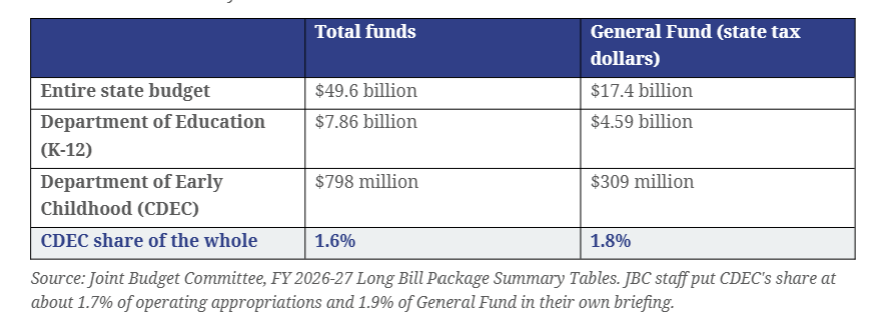
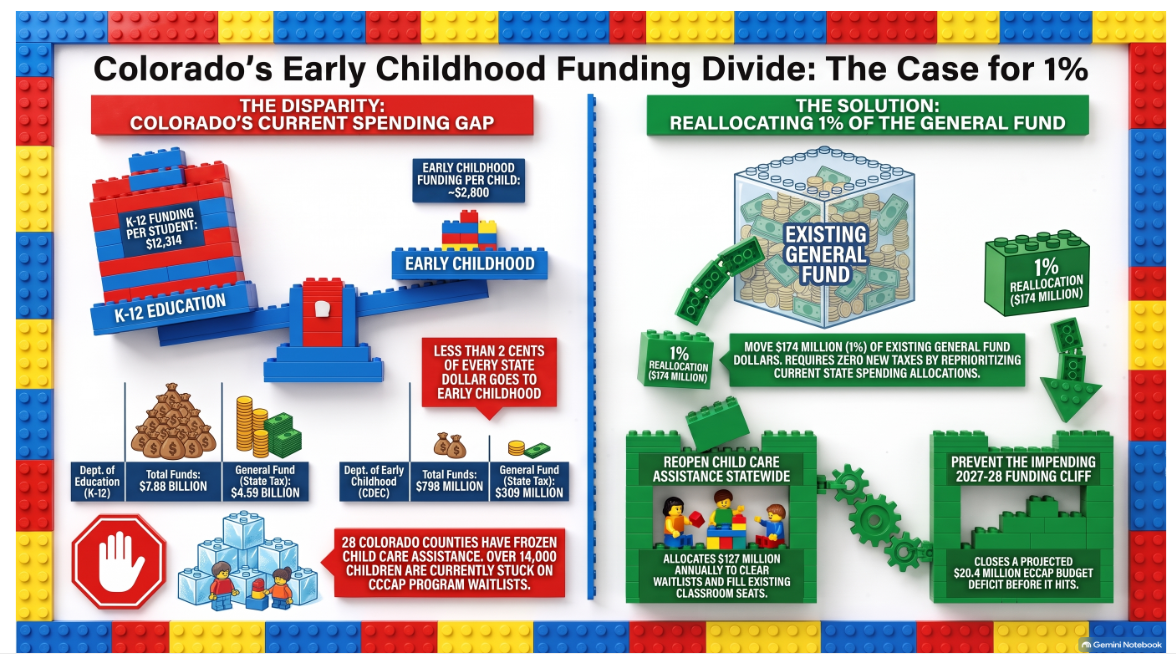
Read that bottom row again. The department that oversees every licensed child care program in Colorado, Universal Preschool (UPK), the Colorado Child Care Assistance Program (CCCAP), early intervention, home visiting, and licensing, runs on less than two cents of every state dollar. K-12 receives about ten times CDEC's total funding and fifteen times its General Fund. Add the local property tax share and K-12 "total program" is $10.2 billion this year, or $12,314 per student, up $438 from last year.
Colorado has roughly 300,000 children under age five. Spread CDEC's entire budget across all of them and it comes to about $2,600 per child. Science tells us the brain builds more than one million new connections every second in those first years. We fund that window at about one fifth of what we fund a fourth grader.
Look inside the $798 million
The total is thin. What is holding it up is thinner.
-
Only $309 million is state General Fund. The rest is federal money ($186 million, and shrinking), cash funds ($288 million, mostly the Proposition EE nicotine tax that pays for UPK), and transfers between agencies.
-
The whole department grew 1.2% this year. Nearly all of the growth went to UPK, which already pulls enrollment away from private programs.
-
CCCAP went backward. Quality initiatives took a $4.5 million federal cut. JBC staff flag a $29.4 million CCCAP funding cliff in the 2027-28 budget year, and this budget does not close it. Twenty-eight counties have already frozen CCCAP enrollment with more than 14,000 children on waitlists.
-
Licensing was cut, not grown. The state ended three licensing contracts and trimmed $0.6 million in General Fund.
A system where public schools sit on a $10.2 billion funding formula with a constitutional floor, while private providers lean on a department funded by a tobacco tax and federal money that is drying up, is not a mixed delivery system. It is one delivery system with a hope that the other one survives.
This is not a request for new taxes. It is a request for priorities.
Here is where ECEA parts ways with a lot of child care advocacy. We are not asking the legislature to go find new revenue. Colorado families and businesses are already stretched by fees, insurance, and housing. We are asking the state to look at the $49.6 billion it already spends and decide whether the first five years of a child's life deserve more than two pennies of every dollar.
The math is not hard. Moving one percent of the General Fund, about $174 million, into early childhood would:
-
End the CCCAP freeze statewide. The state's own estimate is about $127 million a year to reopen enrollment in every county. That money goes into seats that already exist, in programs that are already open, for families already on the waitlist.
-
Close the $29.4 million CCCAP cliff before it hits in 2027-28, instead of waiting for the next crisis.
-
Still leave money on the table to steady licensing and support the programs that keep families working.
One percent. Not a new tax, not a new program, not a new building. The legislature proved in 2022 that it can build a brand-new line item when it wants one: UPK went from an idea to a $300 million-plus program in two budget cycles. Finding one percent for the children and programs already in the system is a matter of will, not capacity.
Prioritizing existing funds also means spending every dollar well. The Child Care Licensure Task Force created by Senate Bill 26-020 is working right now to remove requirements that cost programs time and money without making children safer. Every rule that comes off the books is money that stays in a classroom. Reprioritizing the budget and right-sizing the rules are the same project: put the resources we already have where children actually are.
What legislators will say, and what to say back
"K-12 funding is required by the constitution. Early childhood is not." That is exactly the point. The state chooses what it funds beyond the floor, and every year it chooses to grow other departments by billions while early childhood grows by $9 million. A choice can be changed.
"We just increased UPK funding." UPK serves four-year-olds for part of a day. It does not serve infants, toddlers, or the working family on a frozen CCCAP waitlist. And every UPK dollar routed through a school district is a dollar that does not reach a mixed delivery system.
"There is no money this year." There is $49.6 billion. The question is where it goes.
What you can do this week
-
Know the number. Less than two cents of every state dollar. Say it in every conversation with a legislator, a county commissioner, or a reporter. It is simple, it is sourced, and it is hard to argue with.
-
Ask the question. When anyone tells you Colorado is committed to mixed delivery, ask what share of the budget backs that commitment. If they do not know, you do.
-
Put a face on the one percent. Tell your legislators how many CCCAP children you could serve tomorrow if the freeze lifted. Frozen waitlists are numbers until an owner puts a classroom on them.
-
Members: watch for the session preview. ECEA's CCCAP plan and legislative priorities are built on exactly this case. You will have the talking points and the names before January.
-
Not a member yet? This is the year the budget fight is about you. Join ECEA at coloradoecea.org/join-now and add your voice to the work.
We are in the meetings so you don't have to be. We elevate your voice.
TOGETHER WE ARE STRONGER.
The Early Childhood Education Association of Colorado (ECEA) has advocated for Colorado's licensed private child care and early education programs since 1985. Through legislative representation, administrative advocacy, education, and money-saving partnerships, ECEA helps program owners thrive, so they can focus on the children and families they serve. Together we are stronger.
The ECEA Board Votes Yes on Boulder County's Brighter Start
They listened to owners, they made changes, and they promised to keep listening. That is how you earn a yes.
Your Board read the plan, ran the numbers, and asked the hard questions. Then the ECEA Board of Directors voted to support Brighter Start, the Boulder County early childhood measure on the November 3 ballot.
We do not say yes to new money just because it is new money. We say yes when the people behind a measure treat licensed private programs, centers and homes alike, as partners. Here is why this one earned our support.
They heard you, and they acted
This is the reason that tipped the vote. When ECEA members raised concerns about Brighter Start, the people behind the measure did not wave them off. They worked to understand what owners were telling them, they addressed those concerns in the plan as it stands today, and they committed to keep working with providers as the program is built and rolled out.
That is rare. Too often, child care policy is written about us without us. Boulder County chose a different path, and ECEA members helped shape it. When owners speak up and decision makers respond, that is exactly the kind of partnership this industry needs more of.
What Brighter Start does
Brighter Start raises about $30 million a year through a county property tax of 2.579 mills, roughly $117 a year on a median Boulder County home, starting in 2027. The plan directs the money this way:
-
$20 million for affordability. About $8 million expands the Colorado Child Care Assistance Program (CCCAP), which Boulder County froze for new families in 2024, leaving more than 1,000 families waiting. The other $12 million creates a county sliding-scale program for working families earning up to $150,000.
-
$4.25 million in expansion grants for capital and operating costs so programs can add seats.
-
$2 million for the workforce, reaching roughly 780 early childhood workers.
-
$500,000 for shared services and $2.5 million for county administration.
What it means for your business
The money follows the family to the program they choose. Brighter Start does not build new government classrooms. It pays for care at the licensed program a parent selects, and in Boulder County that program is a privately owned center or home. Enrollment stays with you.
You do not have to be on CCCAP to take part. The county's sliding-scale program is open to programs that choose to serve those families. That gives owners a way in without taking on a subsidy system that has not worked for many of us.
It fills seats that are empty today. More than 1,000 Boulder County families are waiting for help they qualify for right now. Many of those children have a seat waiting in a private program. Brighter Start turns a waiting list into enrollment.
Our seat at the table stays
Support is not a blank check. The Board's yes comes with the same standards we hold for every public dollar: keep administration lean, publish how the money reaches programs, and show that existing businesses are stronger, not weaker, because of it. Boulder County has committed to keep working with providers going forward, and ECEA will be there to hold that promise and report back to you.
What you can do
-
Boulder County owners and directors: vote Yes on Brighter Start on November 3, and share this with the families and staff who vote alongside you.
-
Everyone else: watch Boulder County. When owners raise their voice and local leaders listen, a measure can be written so private programs come out ahead. That can happen in your county too.
-
Want to talk it through? Book time with ECEA. We read the plans so you do not have to, and we make sure your voice is in the room. If you still believe there is too much risk involved in a permanent tax increase, vote no.
Together we are stronger.
We are the workforce behind the workforce.

Don't Just Sign another Overpriced Contract.
We have partners that can help you save AND offer the same or better benefits.
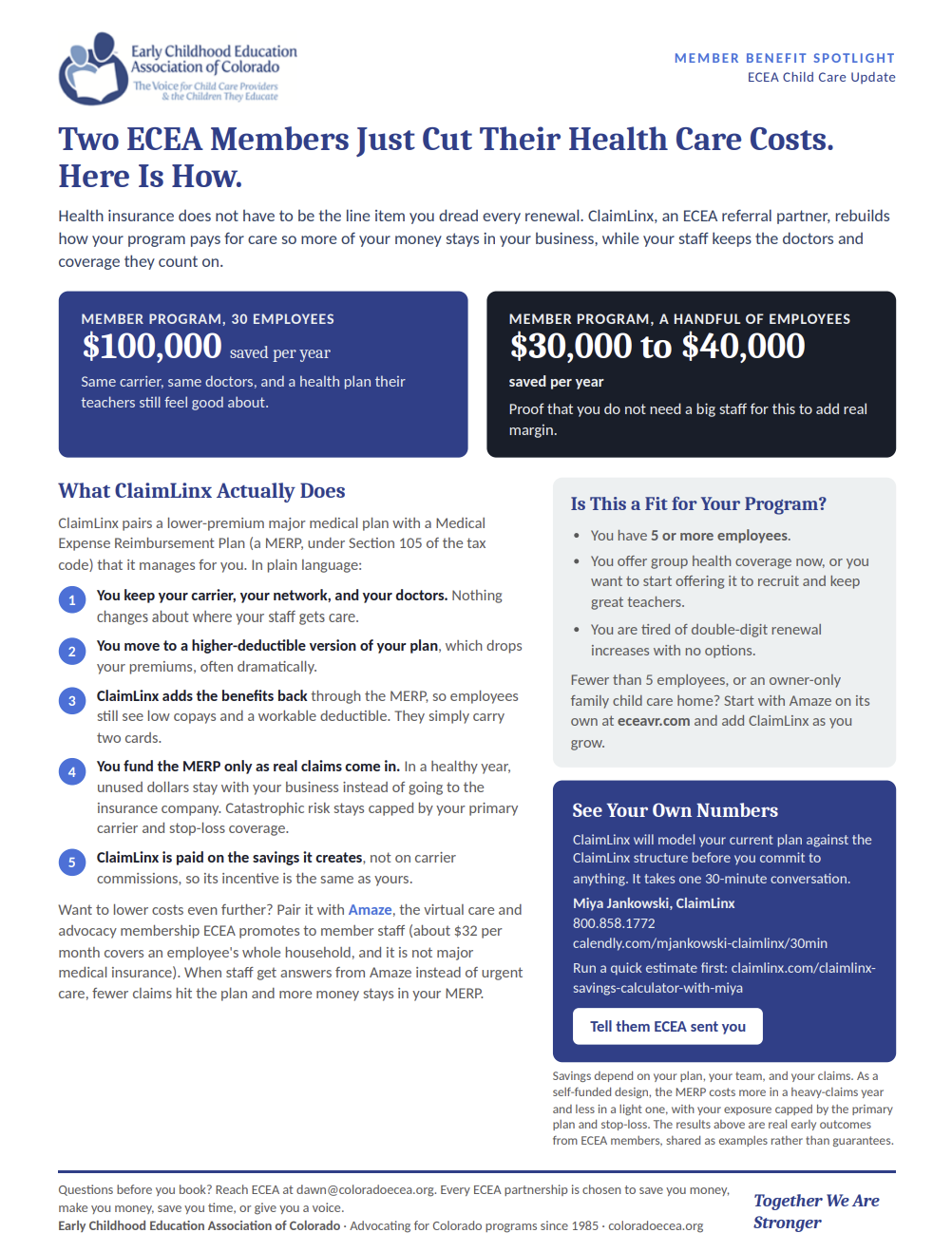
Click on the picture to link to the information page. GREAT news is coming soon on the Amaze track.
SB 20 Task Force Update--
Your Voice Is Already Changing Child Care Rules in Colorado
If you have ever wished that someone writing child care rules had actually run a program, this is the update for you. Since September, ECEA has had a seat at the table on Colorado's SB26-020 Child Care Licensing Task Force. Our charge is simple to say and hard to do: recommend ways to cut the regulatory burden on licensed programs while keeping children safe. Here is where the work stands and how you can shape what comes next.
What the task force is working on
The task force is reviewing four parts of licensing:
-
The rules themselves. Where can standards be streamlined, simplified, or removed without touching safety?
-
Monitoring visits. How can inspections be more consistent, with better trained licensing specialists?
-
Adverse action. How can the process for citations and license actions be fairer and clearer?
-
The licensing report. How can inspection reports be easier for owners, directors, and parents to read and understand?
What has happened so far
The task force kicked off on September 8 and has held three full work sessions, plus a public comment session on September 29. Members have studied how Michigan, Texas, Missouri, and Minnesota recently reviewed and right-sized their child care regulations. Every member has been adding issues to a shared regulatory framework document so that nothing providers have raised gets lost.
In October, the task force began building its list of recommendations from three sources: public comments submitted through the state's online form, task force discussion, and focus groups with providers held across the state. The Colorado Department of Early Childhood (CDEC) has already reviewed the public comments and identified items it can fix on its own through rule changes. Other items will need legislation or new funding, and the task force is sorting each idea into one of those three lanes.
Risk-based monitoring: a big idea on the table
One of the largest topics in October was differential, or risk-based, monitoring. Under this approach, programs with strong compliance histories earn shorter or less frequent inspections, while licensing resources focus where risk is highest. Washington and Georgia use versions of this model, and the National Child Care Quality and Business Support Center joined the October 19 meeting to share what other states have learned. CDEC also shared how it already uses a risk-based approach in school-based sites. The task force is weighing the pros and cons before deciding whether to recommend it for the full mixed delivery system. For a well-run private program, this could mean fewer hours lost to inspections and more time with children and families.
What ECEA is bringing to the table
ECEA's job on this task force is to make sure the owner and director perspective is in every conversation. Among the items we have raised:
-
Room flexibility. License rooms for every age group they could safely serve, and let directors decide which age uses which room, instead of waiting a month or more on a change request. That keeps enrollment moving and lets programs respond to what families need.
-
Scheduled visits where it makes sense. Routine inspections must stay unannounced under federal rules, but follow-up visits for injury reports could be scheduled so you can arrange coverage and have the right staff available.
-
Trusting directors. Directors who already meet qualifications should not be required to keep adding formal education beyond the annual training hours. That is overreach, and we said so.
-
Fewer reporting mandates. Posting enrollment and openings should be a choice that helps you market your program, not a requirement.
-
Investigation limits. Unfounded complaints should not automatically trigger a full inspection.
-
Local council flexibility. Early Childhood Councils should have the funding flexibility to meet the real needs of their area, as defined locally and approved by the state, rather than working inside rigid silos.
We also reviewed the task force's working list to confirm that every concern ECEA members have shared is on it. If you sent us a licensing frustration this year, it is in the record.
What comes next
The task force meets again on November 10. A second public comment session is set for Tuesday, November 17, from 10 a.m. to noon, and the final work session is December 15. Recommendations are due to the legislature by January 1, 2027. The final report will spell out each recommendation, the reason behind it, and whether CDEC can act on it directly, whether it needs a bill, or whether it needs new investment. It will cover centers, family child care homes, school-based programs, and school-age programs separately, so your setting will not get lost in the averages.
How you can help
-
Submit a public comment. The state's online comment form is open. Specific examples from your program carry the most weight: the rule, what it cost you in time or dollars, and what you would change. https://cdec.colorado.gov/resources/sb26-20-child-care-licensing-task-force
-
Attend the November 17 public comment session. Owners and directors speaking in their own words move this process.
-
Send it to ECEA. If you would rather not speak publicly, email [email protected] and we will carry it in.
This is what having a voice looks like. Your membership put a provider at this table, and the rules that come out of this process will be better for it.

Responses