The ECEA Board Votes No on Proposition NN
*Firmly funds the K-12 system, your competition.
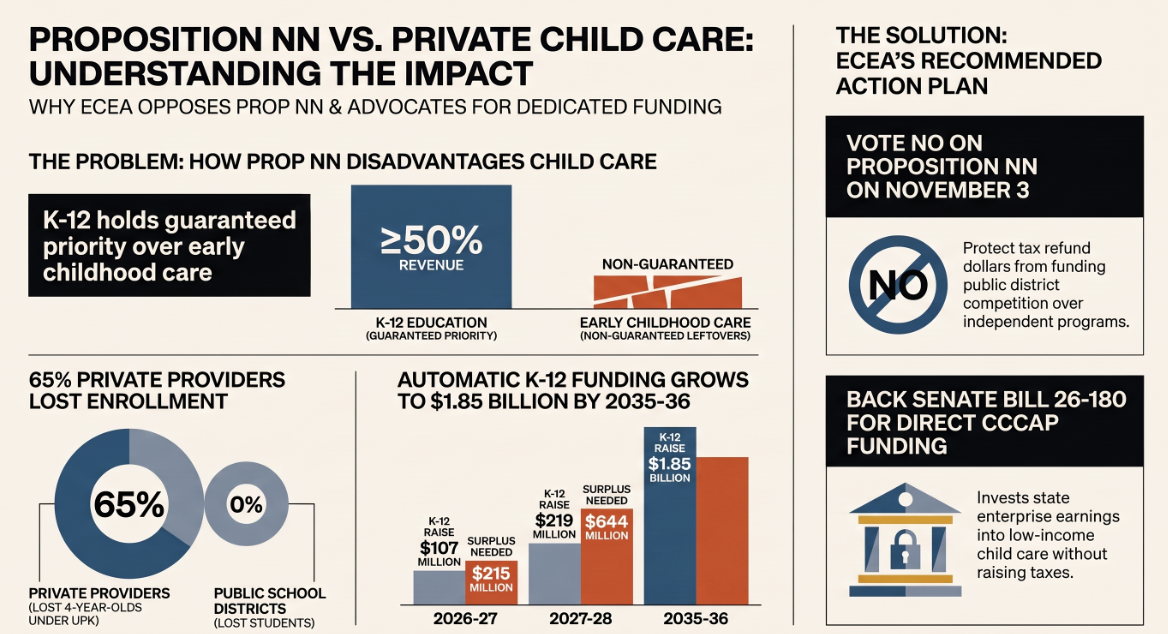
*Funding for early childhood is offered with terms like "might" and "may" because they are leftover funds only! While it may be a lot of money it will only be a temporary influx that gets squeezed out by school districts.
*Pared with a public option would feasibly drive revenue into the school district system
See full details below:
Why a sure thing for child care beats a maybe, and what we are backing instead
Your Board did the homework. We read Senate Bill 26-135, the measure that became Proposition NN. We read the state's own fiscal note. We ran the numbers ten years out. Then the ECEA Board of Directors voted to oppose Proposition NN on the November 3 ballot.
This was not a quick call. In August, we told our members the measure might have real money in it that could reach licensed private programs. That is still true for a year or two. But once you follow the formula, the picture changes. Here is what we found, owner to owner.
What Proposition NN does
Colorado's Taxpayer's Bill of Rights (TABOR) caps how much revenue the state can keep. Anything above the cap comes back to you as a refund. Proposition NN lets the state keep that money instead. The cap goes up by an amount equal to what the state spends on K-12 each year, currently about $4.6 billion, and that change to the cap does not expire. Supporters say the measure raises K-12 funding by up to 50 percent over ten years. Opponents point out that TABOR refunds would shrink or disappear for the foreseeable future.
The bottom line for owners: Proposition NN is a permanent change to TABOR. Child care gets no guaranteed share. School districts, now your primary competition for four-year-olds and soon three-year-olds, get first claim and a guaranteed floor.
Where child care sits in line
Start with what voters will actually see. The ballot question mentions K-12 only: teacher pay, teacher retention, class sizes, and career and technical courses. The words "child care" do not appear. The state's Blue Book says the money the state keeps goes to "K-12 education and programs that support children." That is as specific as the voter guide gets.
The signed law (Senate Bill 26-135, now section 24-77-302 of Colorado law) fills in the order. The money goes into a new "children's account" inside the state general fund and is spent in a fixed order every year through 2036:
-
Property tax reimbursements to counties come off the top (about $206 million in the second year, and growing).
-
K-12 gets its raise first. Two percent of the K-12 funding base, stacking every year, for teacher pay, retention, class size, and career and technical courses.
-
K-12 is guaranteed at least half of whatever is in the account.
-
Early childhood gets what is left. The law says the remaining money goes to "programs that support Colorado's children, prioritizing child care, full-day preschool, and other programs that prepare children to be successful in school." The legislature decides the specifics each year. After 2036, even that language goes away, and the legislature decides everything beyond the K-12 raise.
Notice what is missing. Child care is not on your ballot. It is not in the Blue Book by name. In the law itself there is no line for licensed child care, no line for community-based preschool, and no dollar amount. "Prioritizing" is not a number. The early childhood money, if any, is leftover money in a general fund account, and it can go to any program a future legislature decides supports children, including programs run by school districts.
What has the legislature done with the money it already has?
Look at this year's state budget. Colorado spends about 1.7 cents of every state dollar on the Department of Early Childhood, and 1.9 cents of every General Fund dollar. K-12 gets 28 cents of every General Fund dollar. That is about 15 state dollars for schools for every 1 for early childhood.
Inside that early childhood slice, the state's own contribution to the Colorado Child Care Assistance Program (CCCAP), the program that pays licensed private programs to serve working families, was $37 million this year. That is about two tenths of a cent per General Fund dollar. Nineteen counties froze CCCAP enrollment anyway, and more than 12,000 families and children were shut out. The same legislature found money for e-bike credits and home loan help for educators.
Prop NN hands that legislature more money, no floor for child care, and a spending list it can rewrite with one vote in any future session, without going back to voters. No Blue Book sentence holds them to it. The only thing voters lock in for good is the loss of the refund. Ask yourself what makes this time different.
The squeeze is built into the formula
The K-12 raise grows on a schedule. TABOR surpluses do not. Every year the K-12 share gets bigger, and the leftover for early childhood gets smaller. Nobody has to vote to cut child care. The math does it for them.
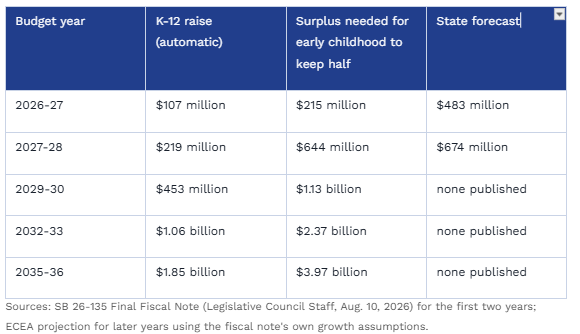
Read the second row closely. Next year's forecast surplus sits only about $30 million above the line where the child care share starts shrinking. By the early 2030s, the K-12 raise alone is larger than almost any surplus Colorado has ever produced. Even if private programs see some funding for a short window, the groups that wrote this bill did not write us a floor. They wrote one for themselves.
Your refund funds your competition
Here is the part that should get every owner's attention. Prop NN takes money that would have come back to you and your families and sends it, first and guaranteed, to school districts. Those same districts now run preschool in more than 90 percent of their elementary buildings in places like Cherry Creek, Aurora, Colorado Springs 11, and Brighton 27J. They pay no property tax. You do. Under Universal Preschool (UPK), they already took the four-year-olds. Three-year-olds are next.
The Common Sense Institute estimates a family earning $50,000 gives up about $60 in refunds through 2028, and a family earning $100,000 gives up about $96. Those are small numbers on their own. Multiplied across every taxpayer, every year, permanently, they add up to the estimated $4.6 billion over ten years. That is money leaving your community and your customers' pockets to strengthen the public option that competes with you.
What you told us
This is not just the Board's read. In September, ECEA asked providers across Colorado, members and non-members alike, what public funding has meant for their business in our Walk It Forward survey. Here is what you said, weighted by the programs each response represents:
-
62 percent say their financial health has declined in the past two years.
-
43 percent say public funding is a net cost to their business once the administration is counted.
-
65 percent have lost four-year-old enrollment, or the full-day families who came with it, since Universal Preschool (UPK) launched. Among centers, 58 percent saw four-year-old enrollment drop. Among home-based programs, 61 percent did.
-
Not one district-operated program reported a drop in four-year-olds. Instead, 64 percent of them reported an increase.
-
60 percent of independent programs said further district expansion could threaten their ability to remain in business. Not one district-operated program saw a threat to its survival.
So much for mixed delivery. UPK did not lift every kind of program equally. It lifted school districts the most. Proposition NN would feed the same pattern, with more money and less transparency.
You also told us you are not against public funding. 73 percent of providers are either ready to support a new measure once protections for private programs are written in, or want real detail on how the money would be distributed and administered before deciding. Prop NN offers neither. It offers the word "prioritizing" and a formula that squeezes you out.
See the full survey results at our Walk It Forward results page.
You asked us to take a stand
85 percent of you want ECEA taking clear, strong positions, or going further. Only 15 percent want a neutral, both-sides approach. Most of you want us to draw the line at business impact, and about a third want us to name names. Asked how our advocacy voice has sounded over the past year, 44 percent said about right, 10 percent said too cautious, and 8 percent said too aggressive. Message received. The Board's vote on Proposition NN is what that looks like. It was not an easy decision to make. You get to make your own on November 3rd when you vote.
The bigger picture: a public option for birth to five
Prop NN does not stand alone. Senator Benavidez is pursuing a bill to create a commission to study the feasibility of a public option for child care. A study commission sounds harmless. It is not. It is the first step toward government-run care for children birth to five, the same path California took when it moved four-year-olds into public school transitional kindergarten and community programs watched their enrollment walk out the door.
If Prop NN passes and the public option bill follows, Colorado gets the California model: districts hold the money, districts hold the children, and private programs hold the bill. Colorado is not a true mixed delivery system today. This would make it less of one.
The sure thing: Senator Bright's low income child care fund
ECEA is not just saying no. We are saying yes to something better. Senator Scott Bright, a child care center owner himself, carried Senate Bill 26-180 this year. It would have let state enterprises invest their idle cash and sent the earnings to counties for the Colorado Child Care Assistance Program (CCCAP), the program that pays for care for working families with low incomes. More than 14,000 eligible children in over 25 counties are frozen out of CCCAP today. Those families need care, and licensed private programs have the open seats to serve them.
That bill does not raise taxes. It does not touch your refund. It does not route money through school districts. It puts dollars into the pockets of parents who choose a program in their community, and those parents choose you. The bill was postponed in Appropriations this spring, and Senator Bright has said he is bringing it back in 2027. That is the solid, ongoing support this industry has earned, and ECEA will be at the table to help carry it.
Private industry has to take a stand while private industry is still here. Together we are stronger.
Click on the picture to link to the information page.
A Message for Members from Senator Bright
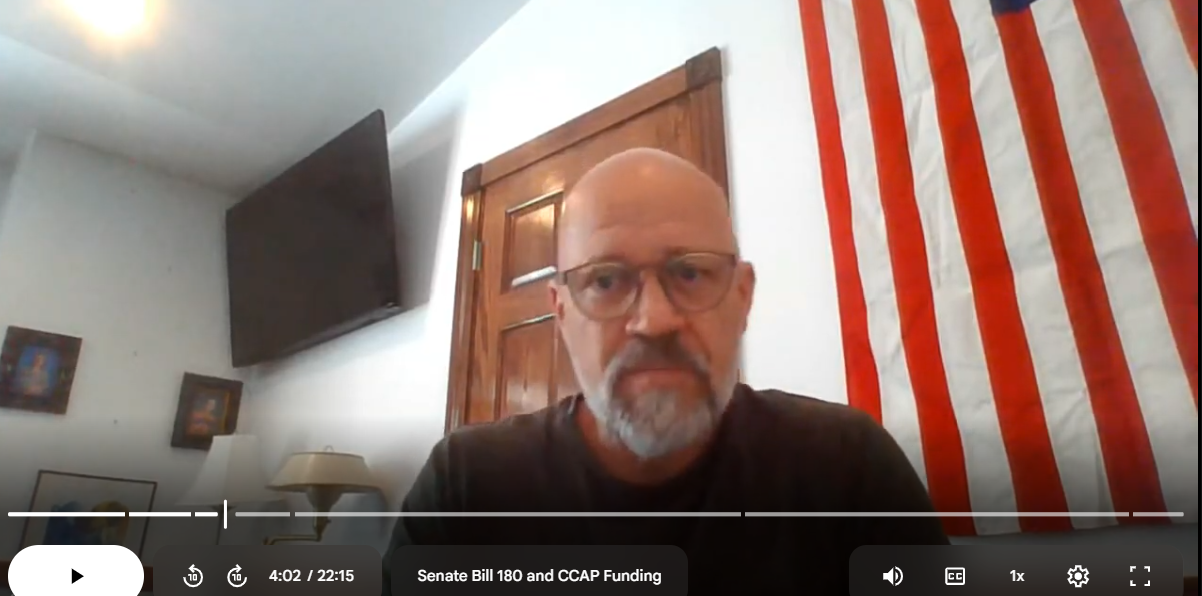
On that note...we need YOU to offer a 15 minute tour to your legislators. Schedule it now and have it before Thanksgiving. Dawn is tracking activity on this as we need EVERY Senator and Representative engaged in a tour so that we can establish this new fund for low income child care!
Pro members...we will be reaching out to ask you to do a one hour licensing feedback session for SB26-20. We need 10 programs to show up! We will email you directly.

Responses