
Watch your inbox today for a Legislative Action Alert....we need YOU in order to fix low income child care. Without you....nothing will change!
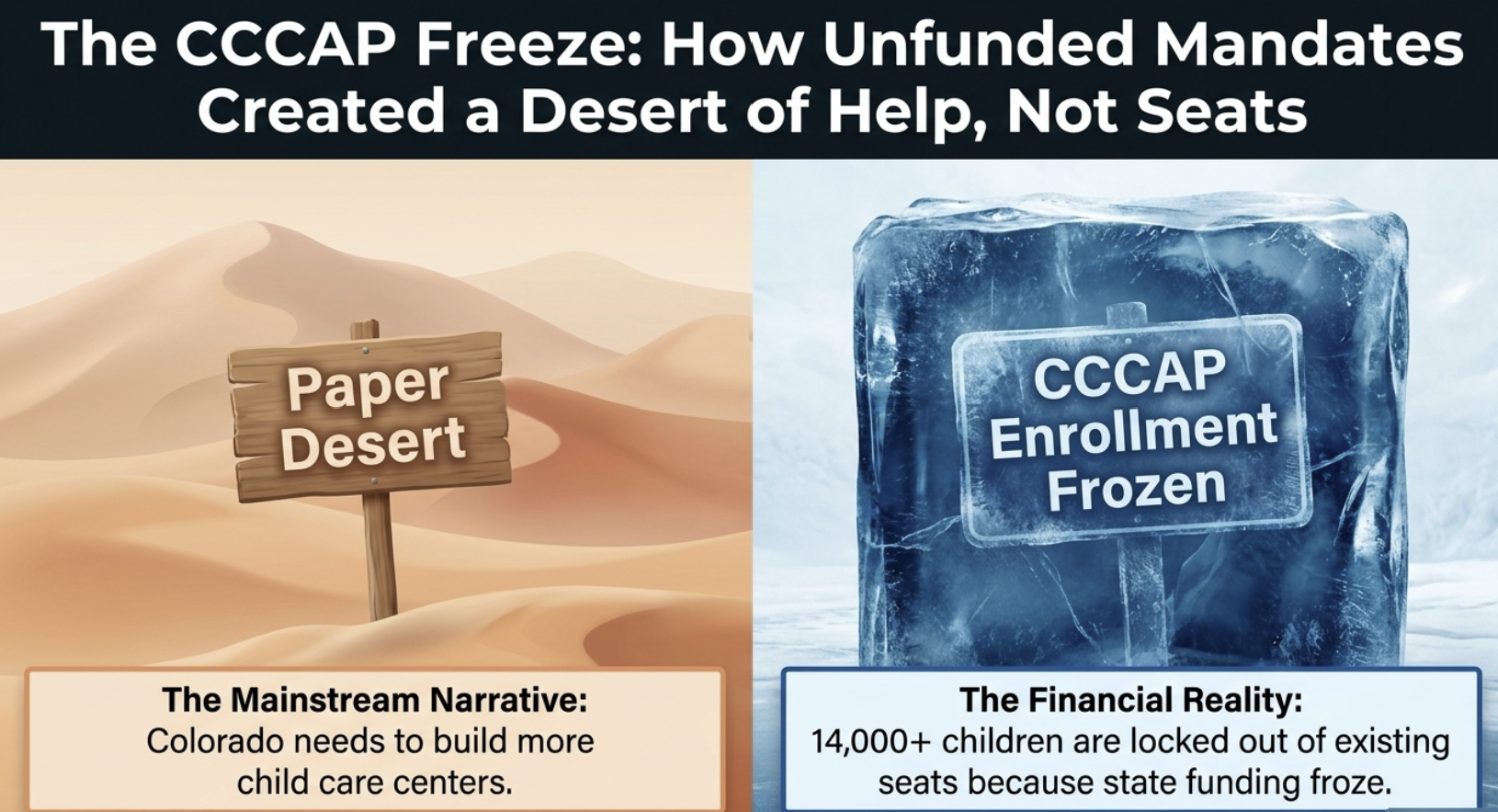
Colorado Has a Child Care Desert. It Is Not the One You Keep Hearing About.
Two "desert" reports landed on our desk this month. One says Larimer County needs more than 7,600 new spaces. The other says Weld County needs more than 14,000 new seats. More reports like them are already in the works for other counties, with a statewide version expected next year. We have heard from members in every county that shares these projections: "Why do we have openings then?" Both cannot be true. Unless you look at how a "gap" gets counted.
How a desert gets built on paper
Here is the recipe, and it is the same in Larimer, in Weld, and in most statewide reports. Take every child under six whose parents all work, using Census data. Call that number "need." Subtract the licensed seats in the county. Whatever is left is the "gap."
Notice what that math never asks. It never asks how many of the existing seats are full. It never asks whether a family uses grandma, a neighbor, a part-time schedule, or a parent who works nights. The Weld slides even say it themselves: more than 80,000 Colorado children with working parents are cared for by family, friends, and neighbors. Then the same slides count every one of those children as needing a licensed seat.
So let us grant the reports their own starting point. About 60% of Colorado families with young children have every adult in the home working. Call that the pool of families who might need care. Statewide, that is roughly 190,000 children under five. Colorado has about 165,000 licensed seats for that age group. Before you count a single grandparent, neighbor, or part-time schedule, there is already a licensed seat for about 87 of every 100 children the reports assume need one. Subtract the 80,000 children the Weld slides say are in family, friend, and neighbor care, and the statewide "desert" disappears. In Larimer County the math is even simpler: 60% of the county's 16,283 young children is about 9,770, and the county has 9,803 licensed seats. That is a seat for every working-parent child in the county. Weld comes to about 14,800 children against 8,205 seats, and yet programs there report closed classrooms and open seats. Supply is not the story in either county.
Look closer at the Larimer claim and it gets shakier. The 7,600-space gap rests on demand projections from 2019, and it says licensed capacity covers only 25% of infant and toddler demand. Since then Larimer has lost a net 45 licensed programs, voters approved a $28 million a year child care tax last November, and the county has had CCCAP frozen since February 2024, longer than anywhere in Colorado. If the seats were the problem, the seats that remain would be full. Owners there tell us they are not.
Now look at what is happening inside the seats that already exist. Providers across the Front Range, in the very counties labeled deserts, have told reporters they are running well under capacity, with classrooms closed for lack of enrollment and infant and toddler slots sitting open. Owners tell us the same thing every week. Colorado Public Radio called it a paradox: more than half the state is labeled a desert, yet spots sit empty. When the seats are not full, the shortage is not seats.
The desert that is real: a desert of help
Colorado does have a desert. It is a desert of the help that used to fill those seats. The Colorado Child Care Assistance Program (CCCAP) is the state subsidy that pays tuition for low-income working families. Right now 28 counties have frozen new CCCAP enrollment. More than 14,000 children are on frozen or waitlists. In 2023 that number was four.
Weld County has been frozen since February 1, 2025. Larimer County was the first in the state to freeze, on February 5, 2024, and has never reopened. The freeze now covers the ten most populous counties in the state. Those children are the ones who used to walk through your doors. Their families still work. The seat is still there. The funding is not.
That is the desert: families who qualify for help and cannot get it, and programs with a ready seat and no way to fund it. Line the two stories up and the "gap" starts to look a lot like a CCCAP-shaped hole.
How did we get here? A 2024 federal rule and Colorado's House Bill 24-1223 raised the state's cost per CCCAP child from about $6,600 to about $18,000. Pandemic relief money ran out in the fall of 2024. The state budget came up short. The state now says it would take about $127 million a year to end the freezes. This spring the legislature passed House Bill 26-1260, which pushes the most expensive pieces of the 2024 rule out to 2028. And in May the federal government rescinded those mandates, so states are no longer required to keep them. The tools to thaw the freeze exist. What is missing is the will to put money into seats that already exist instead of building new ones.
"Nobody can afford child care." Check the math.
Turn on the television or open your phone and you will hear it within minutes: no one can afford child care. Families hear it every day. It shapes what they do. They delay enrolling, drop to part-time, or patch together relatives. That is a real cost driver for your enrollment, and it is worth understanding where it comes from.
An ECEA board member who has run programs for decades put it plainly: the share of a family's income that goes to child care has not really moved. We checked. In 2013, center-based infant care in Colorado cost $13,143 a year, or 15.3% of a married couple's median income. Colorado ranked as the second least affordable state. In 2024, the same care cost $20,978, or 14.3% of married-couple income. Colorado ranked twelfth. Against the median income of all Colorado households, the share was 21.4% then and 21.6% now. Prices rose about 60%. Incomes rose about 58%. Nationally, the day care price index rose 46% from 2014 to 2025 while household income rose 52%.
Child care is expensive. It always has been. Families are stretched by everything: housing, insurance, groceries, and the fees that keep climbing. But the share of the paycheck that goes to your program has held steady for more than a decade. What changed is the volume of the message. That matters for you in two ways. First, empty seats in your building are not a sign that you priced yourself out of the market. Second, when a "desert" report argues for building new supply to bring prices down, the numbers do not support the premise.
The real desert-maker: churn
There is one way a real desert shows up in a community overnight, and it is not in any of these reports. It is a closure. Last week we shared the numbers: more than 1,000 licensed programs closed in Colorado between mid-2023 and mid-2026, about one in five. Nearly nine in ten of them were private. New programs opened in that same window and total licensed seats actually went up. So the state was adding seats on paper while the programs families already knew and trusted were shutting their doors.
Every one of those closures is a shock to a family. A parent has to find a new program, a new commute, a new set of teachers, and sometimes a new work schedule. Owners in Denver tell us there are families who do not drive and have had to move just to reach care after their program closed. That is an extreme impact, and families can absorb it only once or twice before they give up on licensed care altogether and lean on relatives, neighbors, or a parent leaving the workforce. That is how a "desert" is made: not by a shortage of seats, but by seats disappearing from the places families can reach.
This is why the churn has to stop. The Colorado Department of Early Childhood (CDEC) and the state as a whole need to put the same energy into keeping existing programs open that they put into counting the seats we supposedly lack. A program that survives keeps a classroom, a staff, and a set of families intact. A grant for a new building five years from now does none of that. Support the programs that are here today, let them fill the seats they already have, and the system recovers. Without that, it never will.
Where Colorado is truly thin
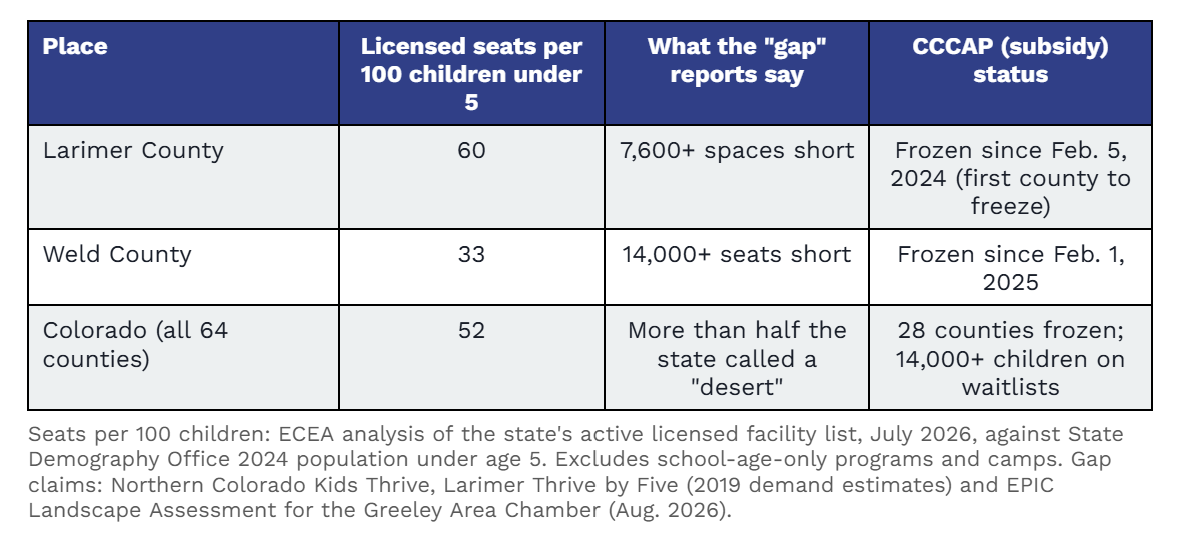
None of this means every community is fine. We pulled the state's active licensed list from July 2026 and matched it to the number of children under five in every county. Colorado has 4,508 open licensed programs. About 3,425 of them serve children under five, with roughly 165,000 licensed seats for about 316,000 young children. That is 52 seats per 100 children statewide, before anyone counts the grandparents, neighbors, and stay-at-home parents who care for a large share of them.
Larimer County sits at 60 seats per 100 children, on the high side for Colorado, and Jefferson County sits at 71, among the best supplied in the state. Weld sits at 33, on the low end, and yet programs there report open seats. Supply is not what separates those counties. Subsidy dollars and family confidence are.
The real thin spots are small and rural. Fourteen counties have three or fewer licensed programs for young children. Jackson County has one program with 15 seats for 41 children. Crowley County has one program for 160 children. Lake County has two programs for about 400 children. Conejos County has three programs and 24 seats per 100 children, the lowest ratio in Colorado. Custer, Sedgwick, Kiowa, Dolores, Bent, Costilla, Gilpin, Mineral, Hinsdale, and San Juan round out the list. Eleven counties, including Logan and Chaffee, have no licensed center infant seats at all; family child care homes carry that load alone. Those are the places where one new home provider or one new center changes a community. That is where "expand supply" belongs. Not in the Front Range counties already at the top of the supply table.
A plan to thaw the freeze, and a job for every member
Naming the problem is only half the work. This week ECEA is sending our members a detailed plan that carries a real solution to the CCCAP freeze into the legislative session that is now taking shape. It is built to put money into the seats that already exist, in the programs that are already open, for the families already on the waitlist. It is practical, it is fundable, and it is ready for the Capitol.
A plan on paper does not thaw a freeze. Members do. We know our members have strong voices, and we know they intend to use them. Owners and directors who show up, who tell their legislators exactly how many children they could serve tomorrow, and who put a face and a classroom on a frozen waitlist are the reason policy moves. Our members are going to work hard on this one, and with the state as a partner instead of a bystander, we fully expect to turn it around.
If you are not yet a member, this is the week to change that. The plan, the talking points, and the seat at the table come with membership. Join ECEA and add your voice to the work.
What you can do this week
-
-
Ask two questions. When anyone hands you a "gap" number, ask how many of the existing seats are full, and how many children in that gap are sitting on the CCCAP waitlist. If they cannot answer, the number is a projection, not a shortage.
-
Report your real numbers in October. Every licensed program is required to report enrollment to the state this October through the Colorado Shines Professional Development Information System (PDIS). Those numbers are how the state, and ECEA, will finally see occupancy instead of projections. Please make them accurate. Do not round up, do not guess, and do not report capacity as enrollment. If the data going in is wrong, the "desert" reports coming out will keep being wrong, and they will be used against you.
-
Members: watch for the CCCAP plan and act on it. It lands in your inbox this week with exactly what to say and who to say it to. Read it, share it with your board and your families, and put it in front of your legislators.
-
Tell your county the seat is ready. If you have CCCAP families on hold, let your county commissioners and your legislators know exactly how many children you could serve tomorrow. Frozen waitlists are easy to ignore until someone puts a face and a classroom on them.
-
Talk to your families about value, not just price. They are hearing every day that care is out of reach. Show them what their tuition buys, what it covered ten years ago, and why the seat you hold for their child is worth keeping.
-
We are in the meetings so you don't have to be. We elevate your voice.
TOGETHER WE ARE STRONGER.
The Early Childhood Education Association of Colorado (ECEA) has advocated for Colorado's licensed private child care and early education programs since 1985. Through legislative representation, administrative advocacy, education, and money-saving partnerships, ECEA helps program owners thrive, so they can focus on the children and families they serve. Together we are stronger.
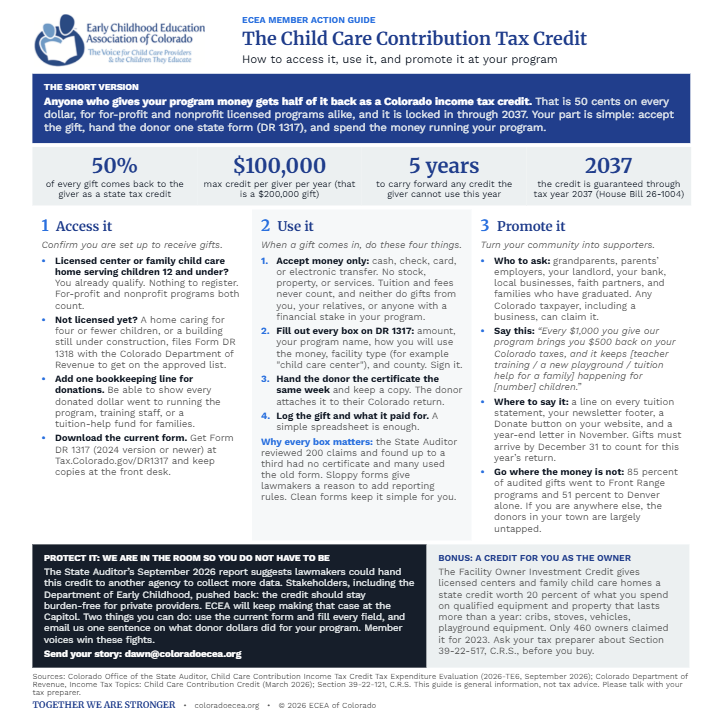
Posted this on our community leadewrship table in case you are looking for it later!
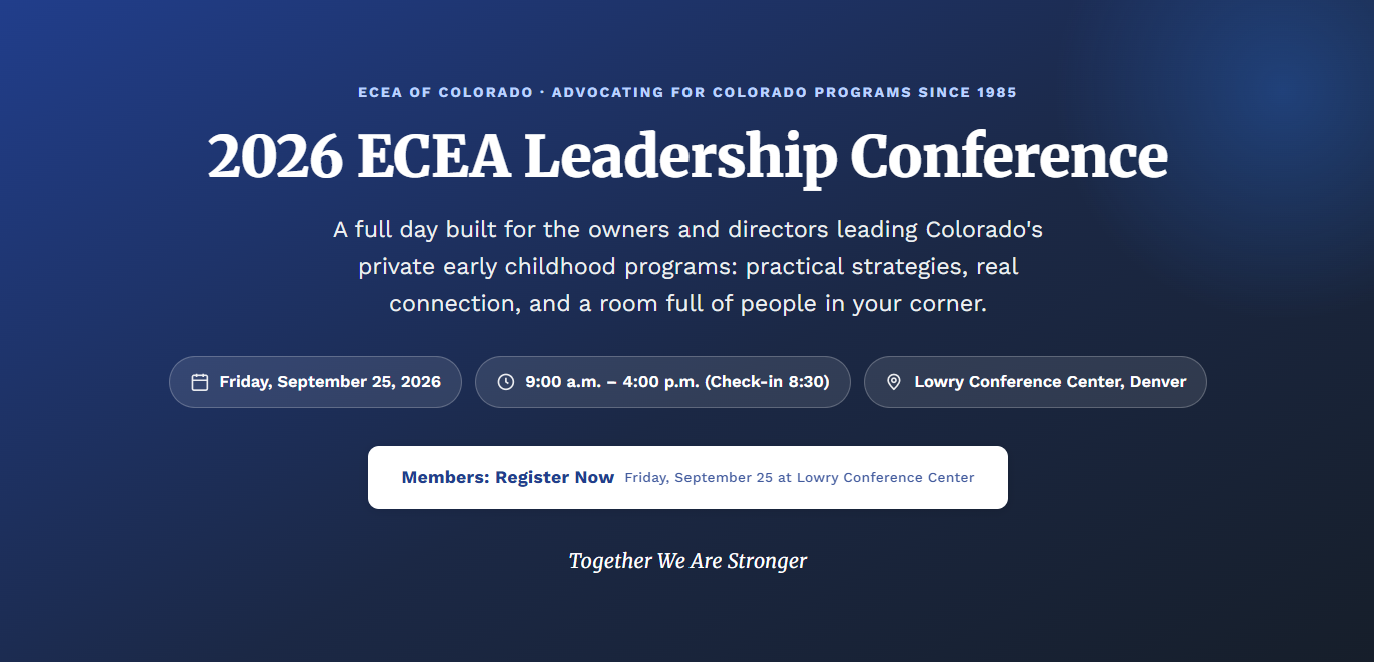
TIME IS RUNNING OUT!! Register today!!
https://www.coloradoecea.org/ecea-leadership-conference
Pro members, email who is coming to [email protected]

This works best if you are not in a low income family, heavily or completely reliant on CCCAP funding. If you are anywhere else this can be a huge help! Do a free consult and find out how and why.
Survey Says....
Here are our member and non-member responses combined.
https://www.coloradoecea.org/walk-it-forward-survey

Responses