
What Is Actually Happening With Head Start?
A Plain-Language Guide to the Proposed Federal Rule for Colorado Providers
The Short Version
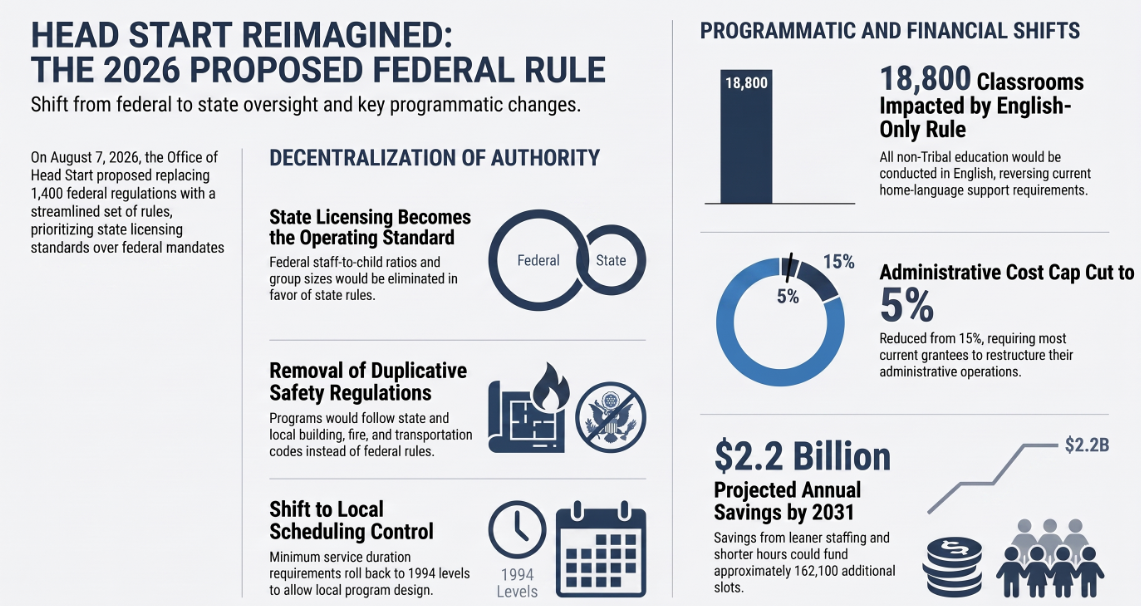
You may have seen alarming headlines about Head Start being dismantled. Here is what the document actually says. On August 7, 2026, the federal Office of Head Start published a proposed rule (formally, a Notice of Proposed Rulemaking) that would repeal the current Head Start Program Performance Standards, over 1,400 detailed federal regulations, and replace them with one streamlined set of rules. The biggest structural change is a shift in who decides: on many issues, including classroom ratios and group sizes, federal requirements would step back and state licensing rules, like Colorado's, would become the operating standard.
This is a proposal, not a done deal. Nothing changes today. The public comment period is open until October 6, 2026, and even if finalized, the changes would phase in starting in 2027. Head Start itself, the program created by Congress in the Head Start Act, remains fully inplace; everything the law requires still applies.
What Would Shift to States and Local Programs
The heart of the rule is deference to state and local authority. If finalized as written, these areas would no longer be set by federal Head Start regulation:
• Ratios and group sizes. Federal staff-to-child ratio and group size requirements would be eliminated. Programs would set and publish their own maximums consistent with state licensing and Child Care and Development Fund (the federal child care funding program known as CCDF) rules. Federal Head Start ratios are currently stricter than nearly every state's licensing standards, including Colorado's.
• Safety, transportation, and facilities practices. Detailed federal requirements would be removed as duplicative of state and local licensing, building codes, and fire codes.
• Background check procedures. The legal requirement to run checks stays (it is in the Head Start Act and the Child Care and Development Block Grant Act), but the prescriptivefederal process rules, such as five-year re-checks, would go away in favor of state law.
• Suspension and expulsion policies. Federal limits would be removed; programs would set discipline policies within state licensing frameworks.
• Hours and schedules. The 2016 minimum service duration requirements (1,380 hours per year for many programs) would roll back to the 1994 floor, letting programs design schedules locally.
One detail worth knowing: about 26 percent of Head Start locations nationally are not state-licensed (school-based, Tribal, and some home-based settings). Those would fall back to baseline federal CCDF health and safety standards.
Other Changes in the Proposal
Several proposed changes go beyond moving decisions to the states, and these are driving much of the reaction:
• English-only instruction. All education would be conducted in English (Tribal language programs excepted). This reverses current requirements to support children in both English and their home language. The government's own estimate: about one third of non-Tribal classrooms, roughly 18,800, would be affected.
• Administrative cost cap cut from 15 percent to 5 percent. Only about 4 percent of grantees currently operate at or below 5 percent, so most would need to restructure; waivers would be available.
• Staff credential requirements narrowed. Qualification rules beyond the statute (for directors, coaches, family service staff, and family child care providers) would be removed, and programs could not require college credits unless proven necessary for the job.
• Health and mental health specifics removed. Requirements like health advisory committees and monthly mental health consultation would leave regulation, though statutory screening and health service duties remain.
• New nutrition and physical activity requirements. Programs would be required to serve nutrient-dense whole foods aligned to the USDA Child and Adult Care Food Program and provide at least 30 minutes of physical activity per three and a half hours, outdoors when weather permits.
• New family content. Programs would be newly required to provide educational material on father engagement and the value of healthy marriage.
What Does Not Change
Everything written into the Head Start Act by Congress stays fully binding: income eligibility rules, parent governance through Policy Councils, the requirement to serve children with disabilities in at least 10 percent of slots, background checks, federal monitoring at least every three years, teacher degree requirements set in statute, the 80 percent federal and 20 percent non-federal funding split, and annual public reporting. Federal officials retain authority to find deficiencies, suspend, and terminate grants. The rule removes regulatory layers on top of the law, not the law itself.
The Numbers Behind the Proposal
The administration projects roughly 2.2 billion dollars in annual cost reductions at full implementation in 2031, and argues those savings stay inside Head Start and could support about 116,500 additional Head Start Preschool slots and 45,600 Early Head Start slots.
Supporters read that as more children served per dollar. Skeptics note the projections assume programs adopt leaner staffing, larger groups, and shorter hours, and that savings only become new slots if programs choose to convert them. Both readings are in the document; how it plays out would depend heavily on state rules and local decisions.
What This Means for Colorado
If this rule is finalized, the increase in Head Start slots would be spread nationwide. Colorado's licensing standards effectively become the floor for Head Start classrooms operating here, on ratios, group sizes, discipline, and safety. That makes state-level rulemaking, where the Early Childhood Education Association of Colorado (ECEA) already represents private providers every day, matter more than ever. Decisions that used to be made in Washington would be made in Colorado, and Colorado's private, licensed child care community would have a real seat at that table.
For private programs that partner with Head Start grantees, or compete with them for families and staff, the proposal could also reshape the local landscape: schedules, staffing credentials, and program structures could look different from one grantee to the next. ECEA will keep watching so you do not have to track 75 pages of the Federal Register yourself.
Want to Weigh In? You Have Until October 6
The agency is specifically asking for comments from people with child care and early childhood operations experience, including how states should handle the transition.
Comments can be submitted until October 6, 2026 at regulations.gov under docket number ACF-2026-0595 (RIN 0970-AD30), or by email to [email protected] with the docket number in the subject line. Every comment becomes part of the public record the agency must consider before finalizing the rule. Your operational experience is exactly the perspective regulators say they want; we elevate your voice.
TOGETHER WE ARE STRONGER
Source: Reducing Federal Burden for Head Start Programs, 91 Federal Register 51248 (August 7, 2026)
Think about everything you have changed in the last five years.
Universal Preschool (UPK) enrollment. Colorado Child Care Assistance Program (CCCAP) rules. Colorado Shines requirements. New portals, new ratios, new reporting, new background check systems. You rebuilt how your program runs, more than once, and you are still open.
Here is what we keep noticing. Every one of those changes had the same three things in common. Somebody else chose it. Somebody else set the deadline. And if you got it wrong, there was a penalty attached to your license.
That is exhausting, and it taught a lot of us something that is not actually true: that all change is dangerous.
There is a second kind of change, and it has none of that. Nobody is going to cite you for changing where you post your jobs. There is no corrective action plan for switching your food vendor. There is no licensing specialist reviewing your website. If you do not like it, you go back, and nothing has touched your license.
That second kind is what our partnerships are. It is the only kind of change that is designed to pay you back, and it is the one most of us have been putting off while we handled everything else.
Over the next few weeks we are going to show you exactly where that money tends to hide, and introduce you to an owner you may know who went and found hers.
Nothing to click today. Just one question to sit with: which line item in your business have you not actually looked at in six years?
You have already done the hard part.
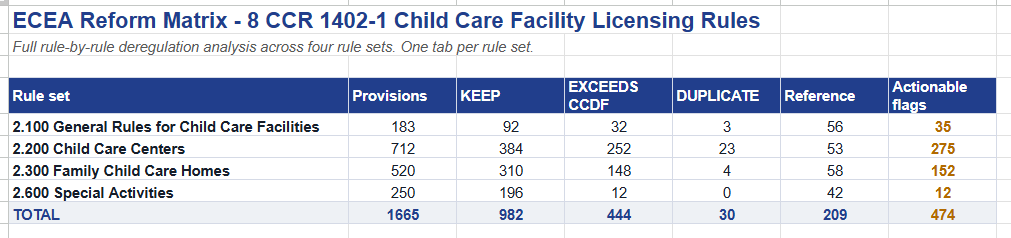
SB20 Work towards Industry Reform (de-regulation) CONFIDENTIAL FOR MEMBERS ONLY!!!
ECEA has asked for member input. We continue to capture and work out potential changes, line by line through four rule sets. Take a look. Email [email protected] if you have other questions/concerns. This is our opportunity to capture. It is an active document and we are working on it as we speak. If you are a pro member, take notes and bring them to our Advocacy meeting next week!
The task force will have it's first meeting in about a week or so.
https://docs.google.com/spreadsheets/d/19qVzEb7j_hR2Nv2AJic2acS-WsxT7h872BwpzxyWWqk/edit?usp=sharing

coloradoecea.org/offers/QLsHrqHr
Plus/Basic/Home/Sacc Members - Register now for the 2026 ECEA Leadership Conference
https://www.coloradoecea.org/ecea-leadership-conference
Sept 25th at the Lowry Conference Center.

Responses